The Secret of Long Legs!

Arvind Singh
| 03-11-2026
 · Animal team
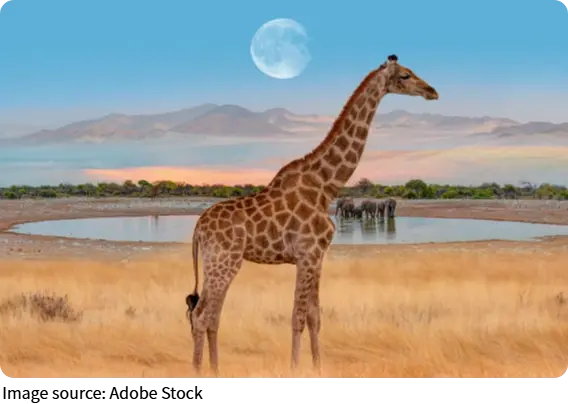
A giraffe’s long legs are among its most recognizable features, but they serve purposes beyond making the animal tall. Along with its long neck, they help it reach leaves high in trees, move across open habitats, and maintain a useful view of its surroundings.
Scientists have also investigated how the giraffe’s body proportions may help reduce the effort needed to circulate blood to its brain.
Built for Reaching High Leaves
One major advantage of long legs is access to food. Giraffes can feed on foliage growing high above the ground, where many other plant-eating animals cannot easily reach. This gives them more feeding opportunities in areas where vegetation is available at different heights.
Their elevated position also provides a broader view across open landscapes. Although height cannot guarantee safety, being able to see farther may help a giraffe notice movement in its surroundings. Long legs therefore influence several aspects of daily life, from feeding to traveling between areas with suitable vegetation.
How Leg Length Affects Circulation
A giraffe’s height creates a challenge for its cardiovascular system. Because its brain sits far above its heart, blood must travel upward against gravity. Maintaining the necessary blood flow requires the heart to generate sufficient pressure. Researchers Roger Seymour and Edward Snelling examined this issue in a study published in the Journal of Experimental Biology in 2025. Their work investigated how a giraffe’s body proportions might affect the energy required to pump blood.
The researchers explored whether long legs help by raising the heart closer to the brain compared with a similarly tall animal whose height comes mainly from its neck. A shorter vertical distance between the heart and brain could reduce the pressure needed to move blood upward. This suggests that the giraffe’s legs may contribute to the efficiency of its circulatory system, as well as its ability to reach food.
A Model Animal Offers Clues
To examine the effect of body proportions, the researchers created a theoretical animal called an “elaffe.” The model combined an eland-like body and legs with a giraffe-like neck, allowing the researchers to compare two different ways of achieving a similar overall height.
Their calculations suggested that the elaffe’s heart would use around 21% of its resting energy, compared with approximately 16% for a giraffe. The difference indicates that the giraffe’s proportions could lower the energy demand associated with pumping blood. However, these figures came from a theoretical model rather than direct measurements of every animal’s daily energy use. They provide evidence for a possible advantage, not a complete explanation of all the factors influencing giraffe circulation.
Evolution Shaped Their Proportions
The development of long legs and a long neck did not happen in a single step. Fossil evidence suggests that limb length increased before the giraffe’s neck reached its modern proportions. This sequence offers a possible explanation for how the giraffe’s distinctive shape developed. Longer legs could have improved access to elevated vegetation while raising the heart relative to the ground.
The Challenges of Long Legs
Long legs are useful, but they can make certain movements more complicated. Drinking water is a clear example. To reach the ground, a giraffe spreads its front legs apart and bends them while lowering its head. This position requires balance and coordination. With its head lowered, the giraffe may also be less prepared to move quickly than when standing upright.
Giraffes have long legs for more than one reason. Their height helps them reach elevated leaves, travel across broad habitats, and view their surroundings. Research also suggests that their leg length may help reduce the cardiovascular effort associated with supplying blood to the brain.
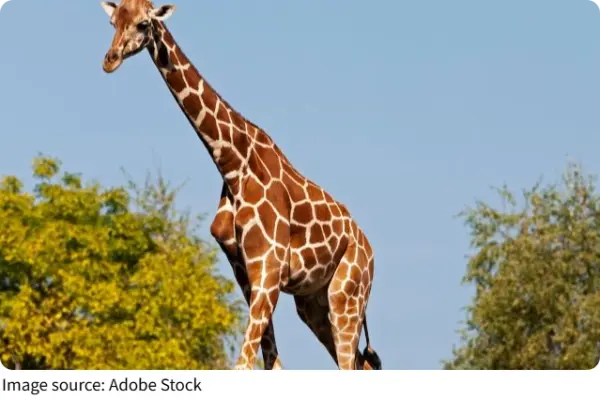
The precise combination of benefits remains a subject of scientific investigation, but one point is clear: a giraffe’s legs are an essential part of its remarkable anatomy. Their length connects feeding, movement, and circulation in ways that make the animal especially interesting to study.