Ostriches Are So Fast

Tessa
| 28-10-2026
 · Animal team
An ostrich may look unusual when standing tall on the African plains, but its real talent becomes clear once it starts running. With long legs, a powerful stride, and an impressive ability to cover ground, this large flightless bird is among the fastest birds on Earth.
Its speed is not simply a matter of moving its legs quickly. Body structure, balance, and efficient movement all contribute to its remarkable running ability.
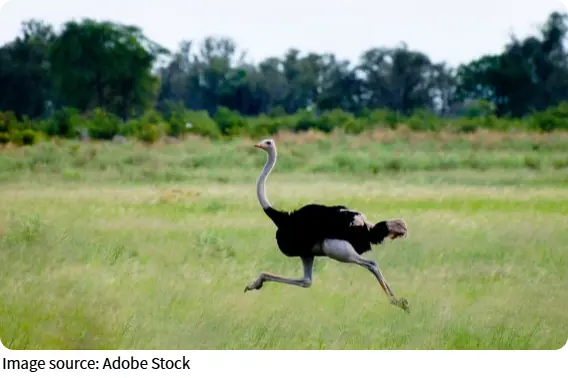
How Fast Can an Ostrich Run?
Ostriches are widely recognized as the fastest-running birds alive. They can reach speeds of around 30 to 37 miles per hour (48 to 59 kilometers per hour), with short sprints reported to reach approximately 43 miles per hour (69 kilometers per hour). Their ability to travel so quickly is remarkable, especially considering their size.
However, maximum sprinting speed and a pace maintained over a longer distance are not the same. A short burst requires powerful acceleration, while sustained running depends on efficient movement and energy management. Ostriches are adapted for both, making them impressive runners across open landscapes.
Long Legs Create Powerful Strides
One of the biggest advantages an ostrich has is its long, muscular legs. Rather than relying solely on short, rapid steps, the bird can cover considerable ground with each stride. Its stride can exceed 10 feet (about 3 meters), allowing it to move forward efficiently.
Strong muscles around the hips and legs provide the force needed to propel the body. Meanwhile, the arrangement of muscles, tendons, and joints supports a smooth-running motion. High speed depends on more than just leg length.
How Its Feet Help Maintain Speed
An ostrich has two toes on each foot, a distinctive feature that supports its running style. This structure helps distribute weight and provides a firm point of contact with the ground during movement. The feet and tendons also contribute to energy efficiency. Elastic tissues in the legs can store and return energy as the bird moves, helping reduce the muscular effort required during repeated strides.
Wings Help With Balance and Turning
Although ostriches cannot fly, their wings still serve useful purposes. During a run, they may extend their wings to help maintain balance and guide changes in direction. Moving quickly across open ground requires more than straight-line speed. A bird must also coordinate its body when turning, especially while taking long strides. Its wings help it adjust its posture and remain stable during movement.
This ability to control direction is valuable in open grasslands and savannas, where uneven ground or obstacles may require adjustments. Strong legs provide forward power, while coordinated movements of the wings and body help the ostrich remain controlled as it runs.
Why Ostriches Are Built for Running
Ostriches are large, flightless birds whose bodies are adapted for life on the ground. Their powerful legs, long strides, and specialized limb structures support fast movement without the demands of flight. Their running ability also involves managing energy. Scientific research on freely moving ostriches has shown that they use different running speeds depending on their movement needs. Their bodies can maintain efficient movement across a range of paces.
Understanding Ostrich Speed Records
Ostrich speed is often described using impressive numbers, but not every reported figure has the same level of scientific support. Some maximum-speed claims are repeated widely despite limited direct measurements under controlled conditions. For this reason, commonly cited sprint speeds should be understood as reported estimates rather than a single universally established record. Exact performance can vary with the individual bird and the circumstances in which its speed is measured.
What remains clear is that ostriches are exceptionally fast runners. Their anatomy provides the strength, stride length, and coordination needed to move across open ground with impressive efficiency.
An ostrich's remarkable running ability comes from several features working together. Long, muscular legs create extended strides, specialized feet and tendons help manage energy, and the wings assist with balance and directional control.
Its speed is not simply an unusual feature of a large bird. It reflects a body well suited to moving across open landscapes. Understanding how these natural adaptations work together makes it easier to appreciate why the ostrich stands out as one of the world's most impressive running birds.