A Lifeline for Cockatoos

Raghu Yadav
| 13-10-2026
 · Animal team
High above Hong Kong's busy streets, an unusual conservation project is giving some of the world's rarest parrots a better chance of survival. Scientists and wildlife specialists are installing artificial nesting boxes in trees, creating much-needed breeding spaces for yellow-crested cockatoos.
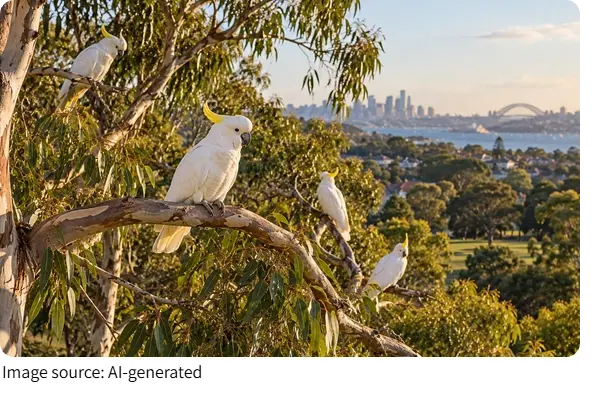
These intelligent white birds, recognised by their striking yellow crests, have become familiar residents of the city. Yet their future remains uncertain as suitable nesting sites disappear.
The project combines practical conservation with modern technology, allowing researchers to observe the birds' behaviour and understand how they adapt to urban environments.
Why Are These Cockatoos Endangered?
The yellow-crested cockatoo (Cacatua sulphurea) is classified as critically endangered, with fewer than 2,000 individuals remaining in its native range in eastern Indonesia and Timor-Leste.
Surprisingly, Hong Kong supports one of the largest populations outside these countries. Approximately 200 birds live freely in the city, representing a significant proportion of the species' remaining wild population.
Scientists believe these cockatoos descended from escaped or released pets. Despite their unusual origins, the population has remained relatively stable, partly because of legal protection and the absence of major natural predators.
Recent genetic research has also revealed unexpectedly high diversity among Hong Kong's cockatoos, suggesting that the population could become valuable for future conservation efforts.
Why Do The Birds Need Artificial Nests?
Yellow-crested cockatoos naturally breed inside hollows in mature trees. In tropical forests, these cavities provide sheltered spaces where parents can raise their chicks. However, suitable nesting sites are increasingly difficult to find in Hong Kong.
Biologist Dr Astrid Andersson, a researcher at the University of Hong Kong, estimates that more than 60% of the city's natural tree hollows have disappeared.
Storm damage and tree maintenance have contributed to this decline, leaving the birds with fewer opportunities to reproduce.
To address the problem, Andersson joined forces with arborist Harry Wong to develop artificial nesting boxes adapted to the city's humid conditions.
How Technology Helps Protect The Birds
Since the project began in March 2025, the team has installed 15 nesting boxes across Hong Kong Island. The structures are positioned in public parks, university grounds and school campuses, including Hong Kong Park and Victoria Park.
Each box contains a small camera connected to a mobile network, enabling researchers to monitor activity remotely. This technology offers valuable opportunities to study courtship, nesting behaviour and parental care without repeatedly disturbing the birds. The information collected may help conservationists improve nesting conditions and develop more effective protection strategies.
Schools Become Part Of The Project
One particularly encouraging example comes from St. Louis School, where cockatoos frequently visit the campus. In April 2026, two nesting boxes were installed after teachers noticed birds attempting to create a cavity in a nearby tree. Within a month, a pair of cockatoos began occupying one of the boxes.
Students have since developed a growing interest in the species, photographing the birds, creating artwork and observing their behaviour.
The school has even adopted the cockatoo as its mascot, turning the conservation initiative into an educational experience.
Are The Artificial Nests Working?
Of the 15 boxes installed, four have attracted pairs of cockatoos. Although the number may appear modest, researchers consider the early response encouraging. Andersson explains that cockatoos often need considerable time to investigate unfamiliar nesting structures before deciding whether to breed inside them.
One particularly memorable success involved a chick discovered inside an apartment's air-conditioning vent.
Conservationists transferred the young bird into a nearby nesting box. After approximately seven hours, its parents located the new shelter and resumed caring for it.
The chick eventually fledged successfully.
What Happens Next?
The team continues refining the nesting boxes, particularly their temperature regulation. Excessive heat inside the structures may discourage breeding. Wong is experimenting with improvements to make the shelters more comfortable, while additional installations are planned. Researchers hope the project will eventually provide more reliable nesting opportunities and contribute to the long-term survival of the species.
For Hong Kong's yellow-crested cockatoos, these artificial homes represent a promising step towards securing their future in an increasingly crowded urban landscape.