Springbok Jumping Skills!

Eleanor
| 10-10-2026
 · Animal team
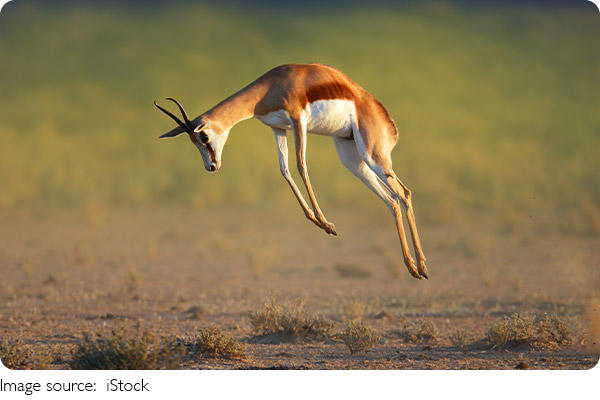
A springbok can suddenly leap into the air with all four feet off the ground, turning an ordinary moment of movement into an impressive display of agility.
This distinctive behavior is one of the most recognizable features of the species, but what makes the springbok such an incredible jumper?
A Body Built for Leaping
The springbok, scientifically known as Antidorcas marsupialis, is a slender antelope adapted to the open, dry landscapes of southern Africa. Its body is relatively light, and its legs are long and well-suited to fast movement across open ground. This combination gives the animal an efficient foundation for sudden bursts of speed and impressive leaps.
The springbok's hind limbs provide much of the power needed to propel its body off the ground. Strong muscles work with the animal's joints and tendons to generate force quickly.
The Famous Springbok Leap
One of the most interesting behaviors is known as pronking. During a pronk, a springbok jumps upward with its back held relatively stiff and its legs moving in a coordinated way. The movement can look almost effortless when several animals perform it together.
Pronking is different from simply jumping over an obstacle. A springbok may perform the behavior while moving across open ground, sometimes making a series of energetic vertical leaps. The exact reason for pronking is not completely settled, and researchers have considered several possible functions, including communication and signaling to other springbok.
Power Comes From the Legs
The springbok's legs are central to its impressive athletic ability. When preparing to leap, the animal bends its limbs and then rapidly extends them. This coordinated action creates the upward force needed to lift its body from the ground.
Its lower limbs also help make movement efficient. In open landscapes, being able to accelerate, change direction, and leap quickly can be valuable when navigating uneven ground or responding to sudden changes in the surroundings. The springbok's movement is therefore not simply about jumping high. Its real advantage comes from combining jumping with speed, balance, and precise control.
Lightweight Movement Matters
A springbok's relatively lean body also contributes to its agility. Moving a lighter body requires less force than moving a much heavier one, making rapid changes in direction and repeated leaps easier. Its body proportions also help distribute movement efficiently.
During a leap, the legs can gather beneath the body and extend again as the animal returns toward the ground. This controlled motion helps the springbok maintain balance rather than simply launching itself unpredictably into the air.
Built for Open Landscapes
Springbok are strongly associated with arid grasslands, shrublands, and other open habitats across southern Africa. In these environments, there are few dense obstacles blocking movement, giving the animal plenty of space to run and maneuver.
That setting makes its physical abilities especially useful. Long legs, efficient movement, and the capacity for sudden leaps allow a springbok to cover open ground with impressive ease. Its jumping behavior is therefore part of a broader set of adaptations that help it move effectively through its natural surroundings.
More Than Just a High Jump
What makes the springbok fascinating is not simply the height of its leaps. Its athleticism comes from the combination of strength, body design, coordination, and balance. The famous pronk adds another layer to this ability, showing how movement can also play an important role in animal behavior.
Watching a springbok leap may look simple, but each jump involves carefully coordinated muscles, joints, and limbs. The animal's body has evolved to make rapid movement possible without wasting unnecessary energy.
The springbok's remarkable jumping ability is a great example of how animal movement can be shaped by anatomy and environment. Add the distinctive pronking behavior, and the springbok becomes one of southern Africa's most memorable examples of natural athleticism.