The Zodiac’s Hidden Order

Mariana Silva
| 08-10-2026
 · Travel team
The twelve zodiac signs can seem as though they were designed simply to match the twelve months of the year.
Their origins, however, reach much further back. Ancient Babylonian astronomers observed the Sun’s apparent journey across the sky and organized the ecliptic into twelve equal sections.
That elegant division became the foundation of a system whose names, symbols, and traditions have endured for thousands of years.
The Zodiac’s Core Idea
As Earth travels around the Sun, the Sun appears to move gradually against the background stars. This apparent path is known as the ecliptic, a narrow band of sky associated with the constellations traditionally used in the zodiac.
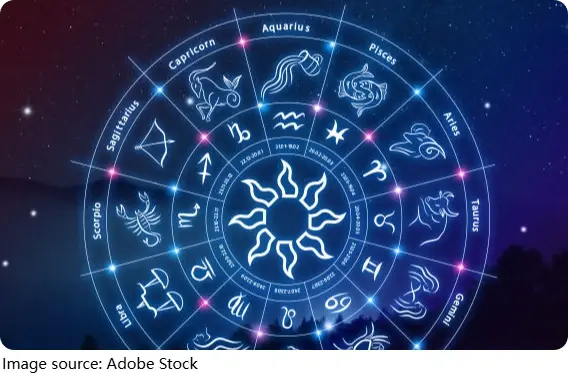
By around the 5th century BCE, Babylonian astronomers had organized this celestial path into twelve equal sections. Each section covered 30 degrees, creating a complete 360-degree circle. The arrangement also corresponded reasonably well with the calendar, as the Sun appeared to move through approximately one section each month.
Why Every Sign Has 30 Degrees
One of the most important details of the zodiac is also one of the easiest to overlook: the zodiac signs are not the same size as the actual constellations.
Constellations along the ecliptic vary considerably in size. Virgo, for example, covers a much larger area of the sky than Cancer. Rather than following those irregular boundaries, the Babylonian system assigned every zodiac sign an identical 30-degree span.
This decision made the system mathematically consistent. Twelve signs multiplied by 30 degrees create the full 360-degree celestial circle, giving the zodiac a simple and orderly structure.

How the Signs Got Their Names
The names of the zodiac signs were drawn from the constellations associated with their original sections of the sky. Aries, Taurus, Gemini, and the other familiar names therefore have deep astronomical roots.
Greek culture later adopted and developed the system, adding mythology and symbolic stories to many of its figures. The ram, bull, twins, and other recognizable images became part of a broader tradition that was subsequently preserved through Roman culture.
The names survived even as the relationship between the signs and the actual constellations gradually changed.
The Sky Has Slowly Shifted
There is another important piece of the story: Earth itself does not maintain a perfectly fixed orientation.
Earth’s axis slowly wobbles, completing a full cycle in roughly 26,000 years. This gradual movement is called the precession of the equinoxes. Over long periods, it changes the position of the equinoxes relative to the background stars.
As a result, the Sun can now appear against a different constellation from the one associated with the traditional zodiac sign for the same date. A person born in late March, for instance, may be traditionally labeled Aries in tropical astrology even though the Sun is actually positioned in front of Pisces.
Two Systems, Two Perspectives
This shift helps explain why different astrological traditions can produce different zodiac signs.
Western astrology generally follows the tropical zodiac, which anchors the signs to the seasons. Aries begins at the spring equinox, and the twelve signs proceed through equal 30-degree divisions.
Another astrological tradition follows the sidereal zodiac, which maintains a closer relationship with the actual positions of the constellations. The two systems are currently separated by roughly 24 degrees, so the same birth date can result in different zodiac signs depending on which system is used.
What Determines Your Sign
In the tropical system, your zodiac sign is determined by the 30-degree section occupied by the Sun at the moment of your birth. It is therefore based on a mathematical division of the ecliptic rather than simply identifying the constellation behind the Sun.
The familiar date ranges, such as Aries from March 21 to April 19, represent traditional tropical boundaries. When a birth occurs close to a sign transition, the precise time and location can become important because the Sun does not change signs at exactly the same clock time every year.
Final Advice For You
The zodiac is ultimately a fascinating meeting point between astronomy, mathematics, history, and symbolism. Its twelve-part structure began with an ancient attempt to organize the Sun’s apparent journey across the sky, while later cultures gave those divisions names, stories, and meanings that remain familiar today. Whether you view the zodiac as a symbolic tradition or simply as a remarkable piece of cultural history, understanding its origins adds another layer to every horoscope you encounter.
This content is for entertainment and general insight only and does not constitute professional advice.