Zodiac vs Constellations

Liam Reilly
| 29-09-2026
 · Travel team
Hi there. Most people meet the zodiac through a horoscope column, where it reads as twelve fixed signs tied to personality.
But look up at the actual sky and you'll find something quite different. The zodiac isn't a set of signs at all.
It's a band of sky, and the constellations inside it are real star patterns you can trace with your own eyes on a clear night.

What the zodiac actually is
The zodiac is a narrow band of the sky that follows the path the sun appears to take over a year. That path is called the ecliptic, and it's tilted about 23.4 degrees from the celestial equator. The moon and the planets stay close to this same band because they orbit near the same flat plane as Earth. So the zodiac isn't a thing in the sky you can point to. It's a zone, roughly 8 to 9 degrees wide on either side of the ecliptic, where the sun, moon, and planets are always found.
Why the twelve signs exist
Astrologers divided that band into twelve equal sections of 30 degrees each, and named each section after the constellation it once lined up with. That's the origin of Aries, Taurus, Gemini, and the rest. The system works as a tidy 360-degree grid. But the sky doesn't stay still. Earth's axis wobbles slowly over about 26,000 years, a motion called precession, and it has shifted the constellations roughly one full sign out of step with the dates most horoscopes still use.
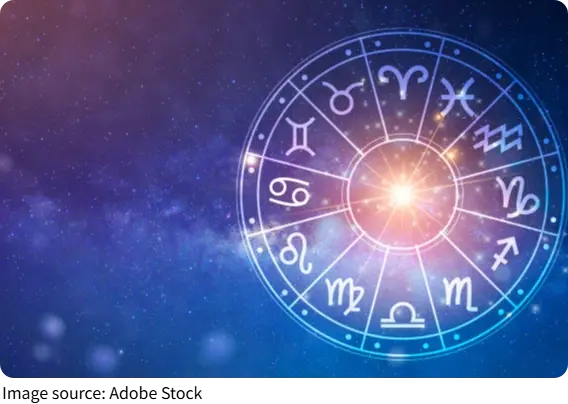
The constellations are the real thing
Remove away the signs and you're left with the actual star patterns. There are 13 constellations that the ecliptic passes through, not 12. The extra one is Ophiuchus, which the sun crosses for about 18 days each year, from roughly November 30 to December 18. Ophiuchus never made the astrological cut, but the sun genuinely travels through it. That single fact is the cleanest proof that the zodiac signs and the constellations are two separate systems.
Where to spot the difference
Go outside and find Orion on a winter evening, or the Big Dipper on a spring night. Neither sits on the zodiac band, so they never host the sun or planets. Now look for Taurus, with its V-shaped face and the bright orange star Aldebaran, or Scorpius low in the summer sky with its curved tail and red Antares. These are zodiac constellations you can actually see. The signs named after them are math, not stars.
Same names, different jobs
So when someone says they're a Leo, they mean a 30-degree slice of sky tied to a calendar. When an astronomer says Leo, they mean a constellation covering about 947 square degrees, the 12th largest of the 88 official constellations. Same word, two completely different jobs. The sign is a date range. The constellation is a region of sky with boundaries drawn by the International Astronomical Union in 1930.
You don't need a telescope to sort this out. Just step outside after dark, find a zodiac constellation like Taurus or Scorpius, and notice that the sun isn't there right now because it's below the horizon. The signs and the stars share names, but they were never the same thing. Next time you read your horoscope, you'll know exactly which sky it's pointing at, and which one it isn't.