Constellation Lines Meaning

Liam Reilly
| 29-09-2026
 · Travel team
Hello, friends. You've seen those dotted lines connecting stars on every star chart, the ones that turn a random scatter of dots into a bear, a hunter, or a swan.
It's easy to assume they mark something actual up there, some physical thread linking one star to the next. But they don't. The lines are a drawing convention, nothing more.
The stars aren't actually close
When you trace Orion's belt across the sky, the three stars look like neighbors sitting in a row. In reality, they're separated by hundreds of light-years. Alnitak sits roughly 1,260 light-years from Earth, Alnilam about 2,000, and Mintaka around 1,200. They only appear lined up because of the angle we view them from. The same goes for almost every pattern you can name. The stars in a constellation are usually nowhere near each other in space. The lines connect them anyway, because from here, on Earth, they happen to fall into a shape your eye can follow.
Why ancient skywatchers drew them
People needed a way to remember the sky before written charts existed. Connecting stars into figures made that possible. A hunter with a belt and a blade is easier to recall than a list of coordinates. Babylonian astronomers were already grouping stars into recognizable shapes by around 1000 BCE, and the Greek poet Aratus described forty-three of them in a work called Phaenomena in the third century BCE. The lines weren't scientific instruments. They were memory aids, and they worked because a story sticks in your head far better than a scatter of dots.
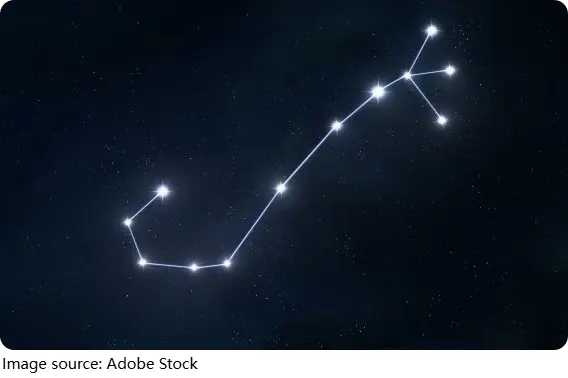
One constellation, many sets of lines
Here's something that surprises people: there is no single official version of the lines. The International Astronomical Union fixed the boundaries between the eighty-eight constellations back in 1922, but those boundaries are invisible rectangles on a chart. The IAU never ruled on how to connect the stars inside them. So a Chinese star map, a modern planetarium app, and a nineteenth-century atlas will draw the same constellation differently. Look at Ursa Major and you'll see the Big Dipper drawn as a full bear in some charts and as just the seven-star ladle in others. Both are considered correct.
What the lines actually help you do
The real value of constellation lines is navigation. Once you learn that the two stars at the end of the Big Dipper's bowl point toward Polaris, you can find true north on any clear night. The lines give you a route. Follow Orion's belt downward and you land on Sirius, the brightest star in the night sky. Trace the arc of the Dipper's handle and it curves to Arcturus. These jumps work because the lines turn a crowded sky into a set of landmarks you can hop between.
Reading a chart without getting fooled
A few things are worth keeping in mind. Brighter dots on a chart usually mean brighter stars, but the size difference is exaggerated for printing. The lines never indicate distance, so two stars that look adjacent might be a thousand light-years apart. And a constellation is not a bound group that moves together through the galaxy. The stars drift on their own paths, and over tens of thousands of years the shapes will slowly fall apart. The Big Dipper won't look like a dipper forever.
So next time you spot those lines on a chart, remember what they are: a human shortcut, drawn to help you find your way around a sky that's far messier and more spread out than it looks. Go outside on a clear night, pick one constellation, and try tracing it yourself. The lines will start to feel like yours.