Aries, the Ram

Mariana Silva
| 29-09-2026
 · Travel team
Hi, readers. Most zodiac constellations get noticed because they're big or bright.
Aries does not. It's a modest little pattern of just a few visible stars, wedged between Pisces and Taurus, and plenty of people scan right past it without realizing they're looking at one of the oldest constellations on record.
But once you know where to aim, it's easy to find, and the story behind its two leading stars is worth the trouble.
Where the Ram actually sits
Aries occupies a patch of sky in the northern hemisphere, roughly between the faint stars of Pisces to its west and the V-shape of Taurus to its east. The constellation reaches its highest point in the evening around late autumn and early winter, which is when you'll get your best look at it. It's bordered by Triangulum, Perseus, and Cetus as well, so if you can find any of those, you're already close. From mid-northern latitudes, look high in the south after dark in November and December. There's no bright landmark star screaming for attention, so the trick is to locate it relative to Taurus and the Pleiades cluster nearby.
Hamal leads the way
Hamal is the brightest star here, and it's your anchor point. It sits at magnitude 2.0, which makes it visible even from a suburban backyard with a bit of light pollution. Hamal is an orange giant, around 66 light-years away, and it's noticeably warmer in color than the white stars around it. That orange tint is a real giveaway once you spot it. The name comes from the Arabic word for a ram or lamb, fitting for the constellation's identity. If you can only find one star in Aries, this is the one you'll see.
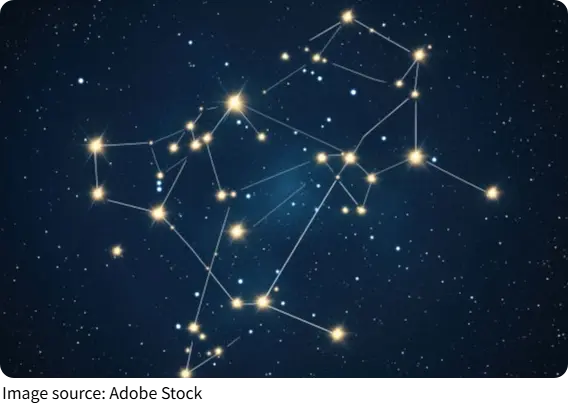
Sheratan and the second star
Sheratan is the second-brightest star, at magnitude 2.6, and it sits just to the northwest of Hamal. The two form a short line that makes up the ram's head. Sheratan is actually a binary system, though you won't split it with the unaided eye. Together, Hamal and Sheratan are the pair that mattered most to ancient sky watchers. Around 2,000 years ago, the spring equinox, the point where the sun crosses the celestial equator, sat right near Sheratan. That's why Aries once carried so much weight in early astronomy and why the sign is still tied to the start of the zodiac.
Mesarthim and the faint third
Mesarthim is the third star worth knowing, and it's a genuine treat for small telescopes. At magnitude 3.9, it's dimmer than the other two, but it's a true double star, two components that split cleanly with modest equipment. The pair has a slight color contrast that makes it fun to observe. Beyond these three, the rest of Aries is faint, mostly fourth magnitude and below. That's the honest reality of this constellation. It's not packed with showpieces, but Mesarthim rewards anyone who points a small scope its way.
Why the position matters
Aries sits along the ecliptic, the path the sun, moon, and planets travel across the sky. That's what makes it a zodiac constellation in the first place. The moon passes through it regularly, and planets slide through its borders too, which means the constellation occasionally plays host to something bright and unexpected. If you check a sky chart and see a planet sitting inside Aries, that's worth a look. The constellation itself stays quiet, but the traffic moving through it does not.
Finding it without a chart
Start with Taurus and the Pleiades, then trace back west. Hamal is the brightest star in the gap between the Pleiades and the faint stars of Pisces, and once you lock onto that orange point, the rest falls into place. Give your eyes 15 to 20 minutes to adjust, and use a red flashlight if you need one. Binoculars help a lot here, especially for pulling out Sheratan and Mesarthim in the same field of view.
Aries won't wow you the way Orion does, and that's fine. It's a quiet constellation with a real history, two stars that once defined the start of spring, and a double star that's genuinely satisfying through a small scope. Next clear night, find Hamal, trace the short line to Sheratan, and take a minute with it. You'll be looking at the same patch of sky that guided calendars thousands of years ago.