Why Scorpius Has That Hook
Pardeep Singh
| 29-09-2026
 · Travel team
Welcome, and let's begin. Most constellations look nothing like the thing they're named after.
You squint, tilt your head, and still can't see a crab or a lion. Scorpius is different. Its J-shaped curve actually looks like a scorpion with a raised tail, and that shape is one of the most recognizable in the night sky.
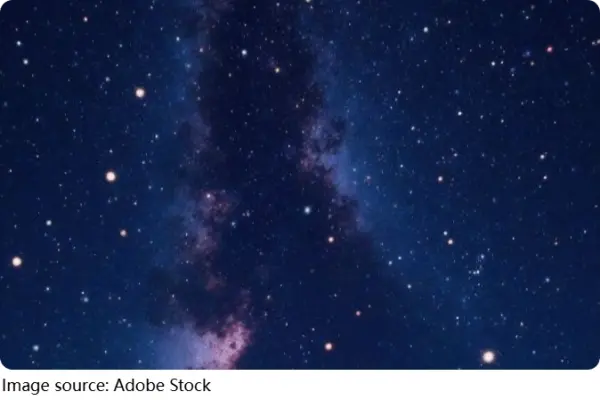
The curve tracks the Milky Way
Scorpius sits right along the Milky Way, and its brightest stars trace the band's curve. The three stars marking the head, Beta, Delta, and Pi Scorpii, form a near-vertical line. From there the body sweeps down to Antares, then the tail curls back up through a chain of stars ending at Shaula and Lesath. The hook isn't arbitrary. It follows the dense star clouds of our galaxy's inner region, so the constellation's shape mirrors the actual curve of the Milky Way in that part of the sky.
Antares anchors the whole thing
Antares is the star that makes Scorpius easy to find. It's a red supergiant roughly 700 times the Sun's diameter, and its name means "rival of Mars" because the color is so similar. In summer, look low in the south and you'll spot that orange-red point glowing against the Milky Way. Once you've got Antares, the rest of the constellation falls into place: the head stars above it, the body below, and the tail curving east.
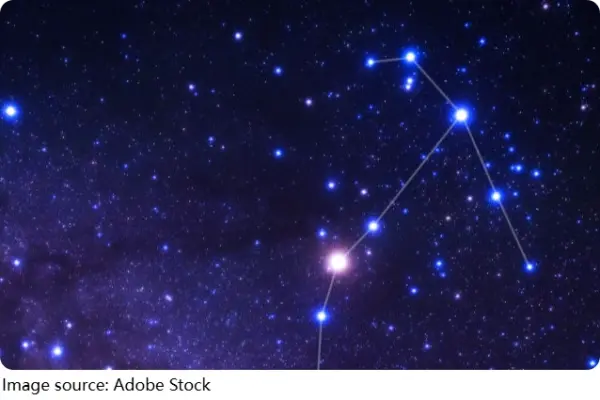
The tail ends in a famous pair
Follow the tail's curve and you reach two stars close together, Shaula and Lesath. They mark the stinger. Their names come from Arabic words for "raised" and "bite," and they sit so near each other that they look like a single bright knot at the end of the hook. In older star maps, this is exactly where illustrators drew the scorpion's stinger, and the curve of the tail was drawn to reach it.
Why the shape sticks in memory
Most constellations need a story to make them memorable. Scorpius doesn't. Its curve is distinct enough that people who don't know any other constellation can still point it out after finding Antares once. That's rare. Orion is the other obvious one, and the two never appear together, since Scorpius rises as Orion sets. In Greek myth, that separation was explained as the scorpion being placed opposite the hunter forever. Astronomically, it's just where each sits along the sky.
How to actually see the curve
Go out on a clear summer evening in the Northern Hemisphere and face south. Antares will be low, maybe 10 to 20 degrees above the horizon depending on your latitude. From there, trace the tail eastward and slightly up. If you're in the Southern Hemisphere, the whole constellation sits much higher and the curve is easier to follow in one sweep. Either way, give your eyes 15 minutes to adjust. The Milky Way behind Scorpius will start to show as a faint band, and that band is what gives the hook its shape.
Next time you're outside on a warm night, look south and find that orange star. Follow the tail from there. You'll see the curve for yourself, and it'll make sense why this is one of the few constellations that actually looks like its name.