Sossusvlei at First Light

Nolan O'Connor
| 09-10-2026
 · Travel team
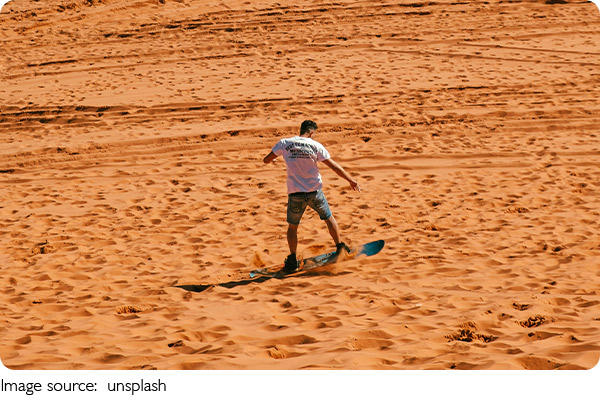
The dune fields around Sossusvlei, inside Namib-Naukluft National Park, are among Namibia's defining landscapes. Wind has shaped these orange dunes over millions of years, creating constantly changing ridges backed by dark rocky mountains and broad gravel plains, just like the scene here.
The destination is surprisingly straightforward once you understand its layout. Everything revolves around one road leading inland from Sesriem, and your biggest decisions are where to stay, which dune to climb, and how early to begin.
Plan the Morning Before You Arrive
The most successful Sossusvlei visit is decided the evening before. Once the sun rises, temperatures increase quickly and the famous dunes become much busier.
Stay close to Sesriem
The entrance to the Sossusvlei area is at Sesriem. From there, a paved road runs about 60 km through the desert before reaching the final access area. The last 5 km consist of deep sand. Visitors without a suitable four-wheel-drive vehicle can leave their car at the designated parking area and continue by shuttle.
Accommodation close to Sesriem is worth the extra cost because it greatly reduces driving before sunrise. Comfortable rooms commonly range from around USD 120–240 per night for two people, while desert lodges with additional facilities are often higher. Campsites provide a more economical alternative.
For two travelers, budgeting roughly USD 300–500 per person for two nights, park fees, meals and local driving provides a realistic planning range, excluding flights and long-distance vehicle rental.
Do not underestimate travel time. Windhoek is approximately 350 km away, and the drive normally takes five to six hours depending on the route and gravel-road conditions. Trying to visit Sossusvlei immediately after arriving from the capital usually leaves very little energy for exploring.
Choose one dune instead of several
Many visitors attempt to climb every famous dune. In reality, selecting one produces a much better experience.
Dune 45 is the easiest choice for most travelers. Rising about 170 metres above the surrounding plain, it can usually be climbed in 30 to 45 minutes and offers wide views across the surrounding dune field.
Big Daddy is much higher at roughly 325 metres and requires considerably more effort because every step sinks into loose sand. Allow between 1.5 and 2.5 hours if you intend to climb it comfortably and continue to Deadvlei afterward.
If this is your first visit, Dune 45 offers the better balance between effort and scenery. Big Daddy suits travelers who specifically want a demanding climb rather than simply excellent desert views.
Carry at least 1.5 to 2 litres of water per person, wear closed shoes that keep sand out, and finish major climbing before late morning whenever possible.
Slow Down Beyond the Dunes
The dunes attract most attention, yet some of the most memorable places lie immediately beyond them. Instead of spending the entire day climbing sand, divide your time between three contrasting landscapes.
Walk across Deadvlei
From the final parking area, the walk to Deadvlei is approximately 1 km each way over soft sand. Most visitors need about 20 to 30 minutes to reach the clay pan.
The famous dead camel thorn trees stand on a bright white clay surface surrounded by towering orange dunes. Because the pan is completely open, shade is almost nonexistent. Early morning provides cooler temperatures and stronger contrast between illuminated dunes and dark tree silhouettes.
Allow about one hour to explore rather than taking a quick photograph and leaving. Walking around the edge reveals how dramatically the appearance changes as the sun moves higher.
Keep to existing walking routes and avoid climbing on the trees or leaving unnecessary footprints across fragile sections of the pan.
Finish at Sesriem Canyon
On your return toward the park entrance, stop at Sesriem Canyon instead of driving straight back to your accommodation.
The canyon reaches roughly 30 metres deep in places and offers a complete contrast to the surrounding open desert. A short walk of 45 to 60 minutes is enough to appreciate the narrow rock walls and the way seasonal water has carved through the landscape over thousands of years.
Late afternoon works particularly well because the canyon provides more shade than the exposed dunes.
If time is limited, skip an extra dune climb rather than skipping the canyon. Seeing both landscapes explains far more about this part of Namibia than standing on another ridge of sand.
Build your day around the light
A practical schedule remains remarkably simple.
Leave accommodation before sunrise, reach the dunes as early as possible, climb one major dune, continue to Deadvlei, return before the strongest midday heat, rest during the afternoon, then visit Sesriem Canyon later in the day.
Trying to include multiple dune climbs, Deadvlei, Hiddenvlei and every viewpoint in a single morning usually creates unnecessary fatigue instead of a better experience.
The cooler months from May to September generally provide the most comfortable hiking temperatures, although mornings can feel surprisingly cold. Pack a light jacket for sunrise and remove layers as temperatures rise.
Sossusvlei is often remembered for its spectacular orange dunes, but the landscape becomes far more interesting once you notice how many environments fit into one relatively small area. Sand ridges, gravel plains, rocky mountains and ancient clay pans all appear within a single day. Give each one enough time instead of chasing every famous name on the map, and the Namib Desert reveals far more than its color alone.