Jordan's Red Desert

Elise
| 09-10-2026
 · Travel team
Southern Jordan is home to one of the Middle East's most spectacular desert landscapes. Vast red valleys stretch between towering sandstone mountains, with ancient rock formations, open plains and scattered desert shrubs creating scenery unlike anywhere else in the region.
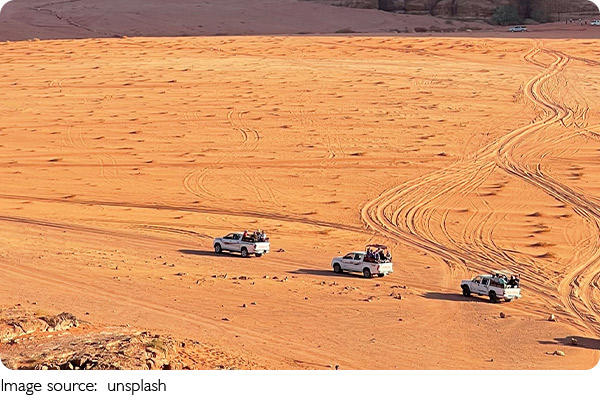
The broad valley shown here is especially impressive in the late afternoon, when warm light gradually transforms the cliffs from pale orange to deep crimson. Spending two nights in the protected desert reserve allows enough time to combine a guided excursion with unhurried walks and a memorable sunset, rather than racing between viewpoints.
Explore Beyond the Jeep Tracks
This protected desert covers more than 700 square kilometres, making it impossible to appreciate in only a few roadside stops. The most rewarding visit balances driving with time on foot.
Build the day around one guided tour
Most visitors begin from the main visitor village, where local guides organize jeep excursions through the reserve. A four- to five-hour tour is usually the best choice, covering major rock formations, open valleys and several opportunities to leave the vehicle.
Shared tours commonly cost around JOD 35–50 per person, while private tours generally start at JOD 120–180 per vehicle, depending on duration and group size.
Rather than choosing the itinerary with the highest number of stops, look for one that includes time to walk. Spending twenty minutes exploring one valley often provides a stronger impression than driving past several landmarks without stopping.
Bring at least 2 litres of water per person, sunscreen, sunglasses and a lightweight scarf. Even during cooler months, the dry desert air increases dehydration more quickly than many travelers expect.
Slow down once you leave the vehicle
The image captures what makes this landscape remarkable: space.
Wide valleys framed by sandstone mountains create enormous natural corridors where distances are difficult to judge. Walking only 1–2 km across the desert floor reveals details that disappear from a moving vehicle, including layered rock surfaces, fossil stream channels and surprisingly resilient desert vegetation.
Look closely at the ground as well as the cliffs. Dark stone shelves, wind-shaped sandstone and scattered shrubs tell the story of a landscape shaped by millions of years of erosion rather than a sea of endless sand.
The most comfortable walking season generally falls between October and April, when daytime temperatures remain pleasant for outdoor exploration. During summer, early morning and late afternoon are much better choices than midday.
Stay for Sunset and Sunrise
Many visitors leave the reserve during the afternoon. Remaining overnight transforms the experience, allowing the landscape to change completely as light shifts across the mountains.
Watch the colours change
Choose one elevated viewpoint overlooking the open valley and arrive 30–45 minutes before sunset.
As the sun lowers, the cliffs gradually shift from bright orange to rich red, while long shadows spread across the valley floor. The change happens slowly, making patience more rewarding than constantly moving to another viewpoint.
Stay at least 20 minutes after sunset. Soft twilight often reveals more subtle colours across the mountains than the final moments before the sun disappears.
Temperatures fall quickly after dark, particularly outside summer. Pack a light jacket even if the afternoon feels warm.
If conditions are clear, look up before returning to camp. The dry desert air and minimal artificial lighting make the evening sky one of the region's greatest attractions.
Spend the night in the desert
Sleeping inside the protected area creates a completely different rhythm from making a day trip.
Traditional camps and modern desert lodges generally range between JOD 60 and JOD 120 per double tent, with many including dinner and breakfast.
For two travelers, JOD 180–280 per person provides a practical budget for two nights, accommodation, meals, park admission, one guided jeep excursion and ordinary local expenses, excluding transport to southern Jordan.
Use the following morning differently from the previous day. Instead of joining another long vehicle tour, take a short walk near camp shortly after sunrise. Cooler temperatures, softer light and quieter surroundings reveal a calmer side of the desert before visitors begin arriving.
If you have additional time, choose one extra activity—such as a camel ride or a guided hiking route—rather than repeating another jeep excursion. Experiencing the landscape at different speeds makes the trip feel far more complete.
Southern Jordan's red desert is remarkable not because of a single viewpoint, but because of how the landscape unfolds over time. Drive through the broad valleys, walk across the desert floor, stay long enough for sunset and sunrise, and allow the changing light to reshape the mountains hour by hour. That slower approach reveals a desert that feels far larger, quieter and more memorable than any quick visit ever could.