Jeju's Volcanic Coast

Vivienne
| 10-10-2026
 · Travel team
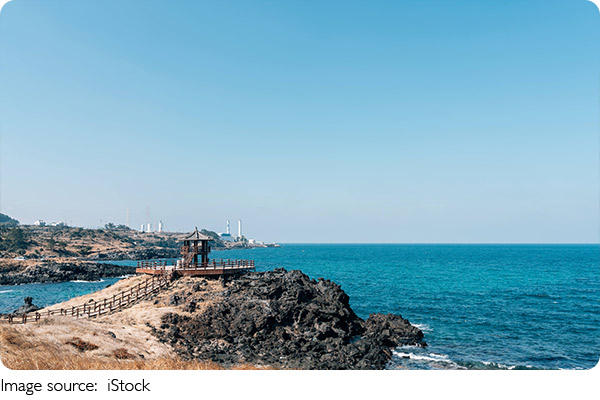
On the eastern coast of Jeju Island, black basalt rocks replace long stretches of sand, creating a shoreline shaped almost entirely by volcanic activity. Around Seopjikoji and Seongsan Ilchulbong, waves meet hardened lava flows instead of soft beaches, producing rugged platforms, rocky inlets and constantly changing tide pools.
A two- or three-day stay on this side of the island gives enough time to experience the coastline from different angles instead of simply stopping for a few photographs.
Understand the Volcanic Landscape
The beauty of Jeju's coastline comes from the interaction between volcanoes and the sea. Once you understand how the landscape formed, every section of the shoreline becomes more interesting.
Walk where lava met the ocean
One of the most rewarding places to experience Jeju's volcanic coast is Seopjikoji, about 5 km from Seongsan Ilchulbong. A complete coastal circuit is approximately 3–4 km and usually takes 1.5–2 hours, although many visitors spend longer stopping at viewpoints overlooking the sea.
Unlike sandy beaches that shift with currents, basalt coastlines remain relatively stable. When lava cooled rapidly after reaching the ocean, it hardened into dense volcanic rock capable of resisting erosion far better than softer sediments. Over thousands of years, waves gradually carved cracks, shallow channels and irregular ledges into these lava flows, creating the rugged coastline visible today.
Walking slowly reveals details many visitors overlook. Some rocks display smooth, rounded edges polished by constant wave action, while others retain sharp fractures where lava cooled and contracted. After rain, the dark basalt becomes almost black, creating an even stronger contrast against the blue sea.
Wear walking shoes with reliable grip. Basalt surfaces can become slippery when covered by sea spray, even when they appear dry.
Visit at different tide levels
The shoreline changes noticeably between high and low tide, making timing almost as important as weather.
At low tide, broad lava platforms emerge from the water, exposing numerous tide pools of different sizes. These shallow pools provide small habitats for sea snails, shellfish, algae and other marine organisms that survive repeated flooding and drying throughout the day.
Rather than walking directly across every exposed rock shelf, stay on established paths whenever possible. Wet algae can make flat-looking surfaces surprisingly slippery, and stepping into shallow pools may disturb fragile marine life.
Morning often provides calmer seas and softer light for photography, while late afternoon brings warmer colours across the cliffs and surrounding grassland. Visiting the same viewpoint twice during one day often produces remarkably different scenery because the angle of sunlight completely changes the appearance of the basalt.
Plan a Better Coastal Day
Instead of rushing between famous landmarks, build your itinerary around several shorter stops that each reveal a different side of Jeju's volcanic coastline.
Combine nearby attractions
The eastern coast is compact enough to explore comfortably within a single day.
A scenic driving route of 20–30 km connects Seopjikoji, Seongsan Ilchulbong, quiet fishing harbours and several ocean viewpoints. Allow 6–8 hours rather than trying to complete everything quickly. Short walks of 20–40 minutes at several locations usually provide a richer experience than spending the entire day at one attraction.
If you rent a car, arrive early at popular sites during weekends and holidays, when parking areas fill more quickly. Public buses also connect the main attractions, although driving offers greater flexibility for stopping at lesser-known viewpoints along the coast.
Bring at least 1.5 litres of water, sunscreen, sunglasses and a lightweight windproof jacket. Even during warm weather, sea breezes can feel surprisingly cool after extended periods beside the water.
Stay near Seongsan
The area around Seongsan provides one of the most convenient bases for exploring eastern Jeju.
Comfortable hotels generally range from KRW 90,000–180,000 per night for a double room. For two travelers sharing accommodation, KRW 350,000–650,000 per person is a practical budget for a three-day stay, including accommodation, meals, local transportation and everyday sightseeing expenses, excluding travel to Jeju Island.
Spring and autumn usually provide the most comfortable temperatures for walking, while winter often delivers exceptionally clear visibility after cold fronts pass. Summer brings greener landscapes but also stronger sunshine and higher humidity, making earlier starts more comfortable for coastal walks.
Many travelers visit Jeju for its beaches, yet the volcanic shoreline tells a far older story. Walking across ancient lava formations, watching waves reshape the coastline and exploring different viewpoints throughout the day reveals how volcanic activity created one of South Korea's most distinctive coastal landscapes. Slow down, follow the coast on foot and let the changing sea and light show a different character at every stop.