Orangutan Facts to Know

Owen Murphy
| 22-09-2026
 · Animal team
Orangutans are among the most fascinating animals found in Southeast Asia. Known for their reddish hair, long arms, and tree-dwelling lifestyle, these great apes have a remarkable combination of intelligence, patience, and adaptability.
They also have a close connection with the forests they inhabit. Here are seven facts that offer a closer look at what makes orangutans so interesting.
Their Name Means “Person of the Forest”
The word orangutan comes from Indonesian and Malay words meaning “person of the forest.” The name is particularly fitting because orangutans spend most of their lives among the trees.
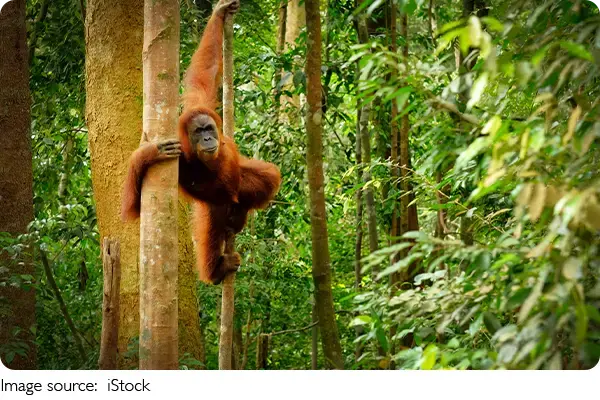
They are highly adapted to forest life, using their long arms, grasping hands, and feet to move between branches. Unlike monkeys, orangutans are great apes and lack an externally visible tail. Their body structure allows them to navigate the forest canopy with considerable control.
There Are Three Orangutan Species
There are three recognized orangutan species: the Bornean orangutan, the Sumatran orangutan, and the Tapanuli orangutan. The Tapanuli orangutan was formally recognized as a separate species in 2017.
Although the three species share many characteristics, they have differences in appearance, genetics, and distribution. Bornean and Sumatran orangutans can also differ in features such as hair length and face structure. All three species are currently classified as critically endangered.
They Are Excellent Tool Users
Orangutans are highly intelligent and can use objects in their surroundings to solve problems. In some wild populations, they have been observed modifying sticks and using them to reach food that would otherwise be difficult to access. Their problem-solving abilities extend beyond simple tool use. Researchers have documented different behaviors among orangutan populations, suggesting that some skills can be learned and passed between individuals.
They Spend Most of Their Lives in Trees
Orangutans are the largest tree-dwelling mammals. Their long arms are especially useful for moving through the canopy, while their grasping hands and feet help them maintain a secure hold on branches.
They also build nests in trees to sleep and rest. Young orangutans learn important skills by observing their mothers, including how to construct these sleeping platforms. Their forest lifestyle means that strong climbing abilities are essential from an early age.
They Help Keep Forests Healthy
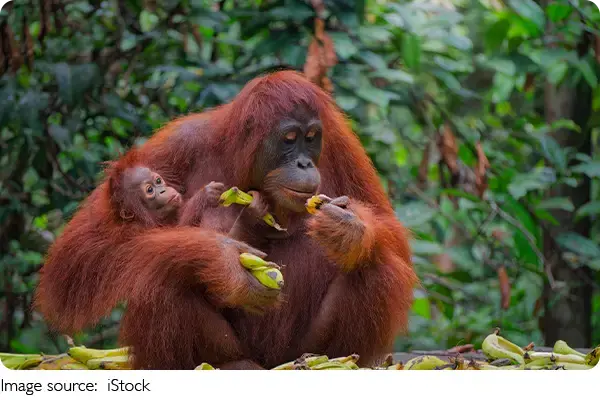
Orangutans eat a wide variety of foods, with fruit making up an important part of their diet. They also consume leaves, flowers, insects, bark, and other plant material depending on what is available.
As they move through the forest and eat fruit, orangutans help spread seeds to different areas. This makes them important seed dispersers and contributes to the natural regeneration of forest vegetation. For this reason, they are sometimes described as gardeners of the forest.
Mothers Teach Their Young for Years
Orangutan youngsters have an unusually long period of dependence on their mothers. During these years, they learn where to find food, which foods are suitable, and how to move safely through the forest. They also learn how to build nests and develop other survival skills by watching and interacting with their mothers.
They Have Remarkable Ways to Find Water
Finding water can sometimes require creativity in a forest environment. Orangutans can obtain water from sources such as tree holes, rainwater collected in leaves, and fruit. Some wild orangutans have also been observed chewing leaves into a soft, absorbent material that helps them collect water from difficult-to-reach places. This behavior is another example of their ability to use materials in their surroundings in practical ways.
From their unusual name and impressive climbing abilities to their sophisticated learning and role in seed dispersal, orangutans have many qualities that make them exceptional great apes. Their lives are closely tied to healthy forests, making their survival important not only to the species itself but also to the ecosystems they inhabit. Learning more about these remarkable animals is a simple way to appreciate the complexity of the natural world.