Inside The Group
Pardeep Singh
| 31-07-2026
 · Animal team
Hey there! An organizational chart looks simple enough—neat boxes and clean lines—until you spend a week there and realize every relationship works completely differently.
Group-living animals reveal that same gap between the tidy version of their social structure and what's actually happening underneath it once researchers look closely enough.
What makes one society more complex than another
Social complexity isn't just about how many individuals live together; it's shaped by the patterns of interaction and spatial closeness between them, and by how much an individual actually needs to recognize and remember about every other member of the group.
Elephants offer one of the clearest examples, living in herds built around deep, layered relationships, where a matriarch's accumulated knowledge, sometimes including memories of resources visited decades earlier, can shape decisions for the entire group during a crisis.
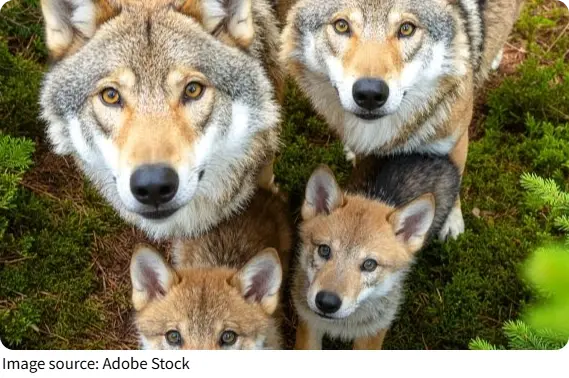
Wolves organize differently, forming packs around a strict hierarchy typically led by a single breeding pair, with rank shaping nearly everything from who eats first to who takes the lead during a hunt.
Where this complexity actually comes from
Researchers have found that surprisingly simple rules, followed consistently by individuals, can generate the elaborate patterns observed at the group level, meaning no single animal needs to understand the whole social system for that system to still function with real sophistication.
Aggression and its patterning play a bigger role than might be expected; the socio-spatial structure of a group often traces back directly to how conflict gets managed and resolved among its members over time.
The physical environment shapes these societies too, though it's a factor researchers admit has been studied less than it probably deserves; the shape and features of available habitat can quietly determine how a group organizes itself day to day.
Recent work on birds has even uncovered forms of complex society in species long assumed to be simple flock animals, suggesting this kind of structure is far more widespread across the animal kingdom than scientists gave it credit for even a decade ago.
What breaks down when the group gets disrupted
These intricate social systems turn out to be fragile in ways that aren't always obvious from the outside.
Removing a single high-ranking individual, particularly in species like elephants where accumulated knowledge sits concentrated in one older animal, can rob a group of decision-making ability that took decades to build up in the first place, with younger members left without the experience needed to navigate a drought or find a safe route during an unfamiliar crisis.
Poaching and habitat fragmentation don't just reduce raw population numbers either; they can quietly dismantle these relationship networks well before a species is anywhere close to extinction on paper, since scattering a once-cohesive group across disconnected patches of habitat breaks the very interactions that made the complex social structure possible to begin with.
Researchers studying this kind of disruption have found that some species never fully rebuild the same level of social complexity even after their numbers eventually recover, suggesting that certain kinds of social knowledge, once lost from a population, may simply not come back on the same timeline as the animals themselves do.

So the next time a herd, pack, or flock looks like a simple, uniform group from a distance, that's rarely the full picture. Honestly, get close enough, and there's almost always a far more intricate set of relationships running the show underneath.