Wind Sailing Secrets

Arvind Singh
| 10-07-2026
 · Sport team
Hello, Lykkers! Have you ever watched a sailboat moving across the water and wondered how it can travel even when the wind seems to come from the opposite direction? At first glance, it may look impossible. After all, how can a boat use wind power when the wind is not pushing it from behind?
Today, we will explore this fascinating sailing secret together. By understanding the design of sails, the role of the rudder, and the skills used by sailors, we can discover how sailboats turn the power of wind into forward movement, even in challenging conditions.
The Basic Idea Behind Sailboat Movement
A sailboat is a type of boat that uses wind energy as its main power source. The most important part of the boat is the sail, which is usually made from strong fabric supported by a frame. Depending on the design, sails can have different shapes, including triangle-like or rectangular forms.
When wind flows across the sail, the curved surface changes the movement of the air. The air moves faster on one side and slower on the other side, creating a difference in pressure. This difference produces a force that pulls the sailboat forward.
The sail does not simply act like a large sheet catching wind from behind. Instead, it works more like a special wing that helps create movement through careful air control. This design allows sailors to use wind from different directions.
How Sailors Control the Direction
Moving forward is only one part of sailing. A sailboat also needs to travel in the correct direction, and this is where the rudder becomes important.
The rudder is located near the back of the boat. Sailors control it by moving a handle connected to the rudder. When the handle changes position, the rudder turns and guides the boat toward a new direction.
For example, when the sailor adjusts the rudder to one side, the water flowing around it helps the boat turn. By making small and careful adjustments, sailors can keep the boat balanced and follow the planned route.
Good direction control is especially important when the boat is moving against the wind because the sailor needs to find the best angle between the sail, the boat, and the wind.
The Secret of Sailing Against the Wind
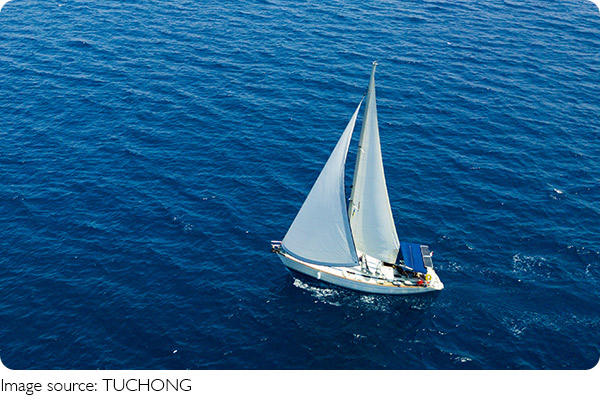
The most interesting part of sailing is the ability to move toward an area where the wind is coming from. A sailboat does not travel directly into the wind. Instead, it moves at an angle, creating a zigzag path across the water.
When the boat moves diagonally, the sail can still receive wind from the side. The shape of the sail changes the wind flow and creates enough force to move the boat forward.
Sailors often repeat this angled movement, turning the boat from one side to another. This technique allows the sailboat to gradually reach a destination that is located in the direction of the wind.
This process requires patience and skill because the boat needs the correct angle to maintain speed. A small change in direction can affect how efficiently the boat moves.
Why Adjusting the Course Matters
When sailing against the wind, choosing the right course is extremely important. If the angle is too wide or too narrow, the sail may not work effectively, and the boat may slow down.
Sailors constantly observe the wind direction, water conditions, and boat movement. They adjust the rudder and the sail position to find the most suitable path.
These adjustments are not done only once. Wind conditions can change from moment to moment, so sailors need to react quickly and make careful decisions.
Through experience, sailors learn how to understand small changes in the environment and use them to improve the boat’s movement.
Helpful Techniques for Better Sailing
Besides controlling direction, sailors use several techniques to improve performance. When the wind becomes stronger, they may reduce the size of the sail area. This helps the boat stay balanced and prevents too much pressure on the sail.
When the wind becomes weaker, sailors can open the sail more to capture additional airflow and create stronger movement.
Sail position also plays an important role. By adjusting the ropes connected to the sail, sailors can change the sail’s angle and improve the way it works with the wind.
The angle of the boat itself also matters. A skilled sailor combines these small adjustments to create smoother movement and better control.
The Challenges of Moving Against the Wind
Although sailboats can travel against the wind, this method has some challenges. Compared with sailing with the wind behind the boat, this process usually takes more time because the boat follows a longer route.
Weather conditions, water movement, and changing wind patterns can also influence the journey. Sailors need to consider many factors before choosing the best route.
However, these challenges are part of what makes sailing exciting. The combination of knowledge, observation, and skill allows sailors to work with nature instead of simply depending on wind direction.
Conclusion: Discovering the Power of Wind
So, Lykkers, the next time we see a sailboat crossing the water, we can look at it in a new way. Its journey is not simply about catching the wind. It is about using smart design, careful control, and sailing techniques to transform wind into movement.
The ability of a sailboat to move against the wind shows the creativity of human engineering and our connection with nature. Have you ever seen a sailboat in action, or would you like to experience sailing someday? Share your thoughts with us and continue exploring the amazing stories hidden in everyday science.
How Sails Work or How Sailboats Sail into the Wind
Video by Stick Science