Alpine Lakes Like Jewels

Owen Murphy
| 08-07-2026
 · Travel team
Lykkers, in the far southeastern corner of Switzerland, a high-altitude valley cuts through the Graubünden Alps at elevations above 1,800 meters, holding a chain of turquoise lakes so vivid they look artificially colored. The Engadine Valley—stretching from Maloja Pass to the Austrian border—is home to St. Moritz, to the UNESCO-listed Bernina Express railway, to forests hiding crystal-clear swimming lakes, and to some of the most dramatic hiking terrain in the Alps. This is a place where the air is thin, the light is sharp, and the landscape operates at a visual intensity that few alpine regions can match.
Bernina Express
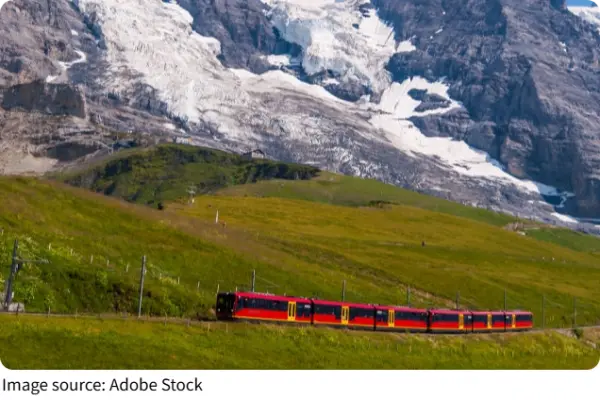
The Bernina Express—a UNESCO World Heritage railway—connects St. Moritz to Tirano, Italy, crossing 196 bridges and passing through 55 tunnels while climbing to 2,253 meters at Ospizio Bernina. The journey takes approximately four hours through glacier valleys, past turquoise alpine lakes, and over the famous Landwasser Viaduct. A mandatory seat reservation costs approximately $35 (CHF 32) per person for the short route from St. Moritz. Full-route reservations (Chur to Tirano) cost $44 to $48 (CHF 40 to CHF 44) depending on season. Travelers holding a Swiss Travel Pass ride free on the base ticket and pay only the reservation fee. Budget alternative: the identical route is served by regular regional trains at standard ticket prices with no reservation required—same tracks, same views, more schedule flexibility.
Lake Staz Swim
Tucked in an Arolla pine forest between St. Moritz and Pontresina, Lake Staz (Lej da Staz) is a small, warm-water alpine lake that glows emerald green in sunlight. Swimming is free—no entrance fee, no lifeguard, just a forest clearing with water temperatures that reach surprisingly comfortable levels by July and August. The lake is a 15- to 20-minute walk from St. Moritz through the forest, or accessible by local bus. A small lakeside restaurant serves drinks and simple meals for $12 to $22 (CHF 11 to CHF 20). In winter, the frozen lake becomes part of a horse-drawn carriage route through the snow-covered forest.
Hiking Trails
The Engadine's trail network covers hundreds of kilometers at elevations where the air is noticeably thinner but the views are proportionally more dramatic. The Muottas Muragl to Alp Languard panorama trail—a moderate four- to five-hour walk—delivers uninterrupted views of the Upper Engadine lake chain and the Bernina Massif. The Val Roseg valley hike from Pontresina leads to glacier viewpoints of Piz Bernina (4,049 meters) and Piz Roseg. Cable cars access higher trailheads—single round-trip tickets cost $22 to $66 (CHF 20 to CHF 60). A multi-day hiking pass covering most mountain railways costs approximately $115 (CHF 105) for two days or $315 (CHF 288) for seven days.
Where to Stay
St. Moritz is famous for luxury, but the Engadine offers accommodation at every level. Youth hostels in St. Moritz and Pontresina provide dormitory beds from approximately $55 to $77 (CHF 50 to CHF 70) per night. Budget hotels start from $110 to $165 (CHF 100 to CHF 150). Mid-range three-star properties range from $220 to $385 (CHF 200 to CHF 350) nightly. Luxury resorts—including the legendary Badrutt's Palace and Kulm Hotel—command $550 to $880+ (CHF 500 to CHF 800+). Staying in Pontresina, Samedan, or Celerina rather than central St. Moritz often saves 20 to 30 percent on accommodation while keeping all attractions within easy reach by bus or train.
Eating Affordably
Switzerland's restaurant prices are among the highest in Europe—but strategies exist. Supermarkets (Coop, Migros) offer prepared meals, sandwiches, and salads for $8 to $15 (CHF 7 to CHF 14) per meal—ideal for trail lunches. Casual sit-down restaurants serve main courses for $22 to $44 (CHF 20 to CHF 40). Mountain hut restaurants along hiking trails offer hearty soups, sausages, and Rösti for $16 to $28 (CHF 15 to CHF 25). Tap water throughout Switzerland is excellent and free—carrying a refillable bottle eliminates bottled water costs entirely.
Getting There
The nearest major airport is Zürich (ZRH), approximately 3.5 hours from St. Moritz by train. The train journey itself is scenic, passing through the Rhine Gorge and over alpine passes. A second-class ticket from Zürich costs approximately $55 to $88 (CHF 50 to CHF 80) at standard fares, with the Swiss Half Fare Card ($132 / CHF 120 for one month) cutting all ticket prices in half. Milan Malpensa airport (MXP) offers an alternative southern approach—train via Tirano and the Bernina route takes approximately four hours.
Readers, the Engadine Valley operates at elevations where the light is sharper, the lakes are bluer, and the silence between mountain peaks feels like something you can almost touch. It is expensive—Switzerland always is—but the combination of UNESCO railways, glacial hiking, and forest-hidden swimming lakes delivers an alpine experience that justifies every franc. If you could ride a train across 196 bridges through a glacier valley, would you choose the panoramic car or the open window?