Rise of Autonomous Cars

Ravish Kumar
| 26-05-2026
 · Automobile team
The first time most people see a robotaxi pull up without a driver behind the wheel, something shifts. It's one thing to read about autonomous vehicles.
It's another to watch a car navigate a busy intersection, signal, merge, and stop at a curb without any human doing any of it.
That moment is no longer confined to technology demonstrations and closed test tracks. Waymo is already running commercial driverless services in multiple U.S. cities, and the technology continues to expand. The age of the autonomous vehicle has quietly begun.
At the heart of every self-driving system is a set of capabilities that have to work together with extraordinary precision. The vehicle needs to perceive its surroundings, make sense of what it perceives, plan a response, and execute that response in a fraction of a second, across thousands of different scenarios, in real traffic, with real consequences.
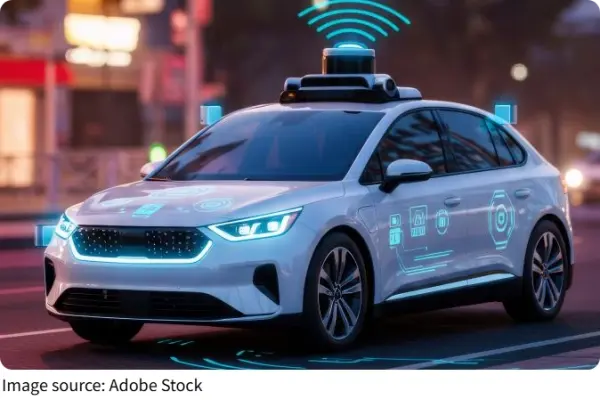
Cameras provide visual data about lane markings, traffic signals, pedestrians, and other vehicles.
Radar measures the distance and speed of nearby objects and functions reliably in rain, fog, and darkness. LiDAR fires pulses of laser light and builds a three-dimensional map of the surrounding environment by measuring the time it takes those pulses to bounce back. Together, these systems generate millions of data points per second.
Where AI Comes In
Sensing the world is only step one. Interpreting it is where artificial intelligence becomes essential. Deep learning systems, trained on enormous datasets collected from millions of miles of real-world driving, allow autonomous vehicles to recognize objects and predict behavior.
When a pedestrian approaches a crosswalk, the system estimates whether that person intends to step into the road. When a vehicle ahead brakes suddenly, the algorithm evaluates whether to brake, change lanes, or hold course. These decisions happen faster than a human driver can consciously react.
High-definition maps add another layer of precision. These maps contain detailed information about lane positions, traffic signals, road curvature, and physical infrastructure, and they're accurate to within centimeters. The vehicle compares live sensor data against these maps to determine exactly where it is and how to proceed. GPS alone isn't precise enough for this kind of navigation, which is why the combination of satellite positioning, sensor fusion, and HD mapping has become standard in serious autonomous systems.
The Safety Argument and the Challenges Against It
The case for autonomous vehicles rests heavily on safety. Human error is the primary cause of the vast majority of road accidents worldwide. Fatigue, distraction, and delayed reaction times cause fatalities every day. Autonomous systems don't get tired, don't look at their phones, and respond to hazards faster than human biology allows. Waymo's own data showed significantly fewer serious injuries in its autonomous fleet compared to average human drivers. If those numbers hold at scale, the human cost reduction alone could justify the technology's development.
But the safety argument is also where autonomous vehicles face their hardest challenges. Real-world driving is unpredictable in ways that are genuinely difficult to engineer around. Unusual weather conditions can interfere with sensors. Road surfaces vary enormously across regions. Human drivers behave in ways that no training dataset fully captures. The system has to be right not just most of the time but essentially all of the time, because the consequences of failure on a highway at speed are severe.
Cybersecurity is another serious concern that gets less attention than sensor performance. Self-driving vehicles are software-heavy systems connected to the broader digital world. That makes them potential targets for attacks that could have physical consequences. Regulatory frameworks also lag behind the technology, creating uncertainty about liability, insurance, and what standards vehicles must meet before deploying on public roads.
What Autonomous Vehicles Could Change Beyond the Car Itself
The economic and urban implications extend far beyond the driving experience. Autonomous freight vehicles could restructure logistics, allowing trucks to operate continuously without driver rest requirements. Ride-sharing fleets running around the clock without driver costs could make transportation significantly cheaper and more accessible. For elderly people and those who cannot drive due to disability, fully autonomous vehicles represent genuine mobility independence.
Cities themselves could change shape. The need for large parking lots in city centers diminishes if cars can park themselves remotely. Traffic flow could improve significantly if vehicles communicate with each other and with road infrastructure, coordinating movement rather than competing for space. However, the counterargument is real: if autonomous vehicles make travel easier and cheaper, people may simply travel more, increasing total vehicle miles and potentially offsetting the efficiency gains.
The transformation is happening, but it's progressing more gradually than early projections suggested. The technology is real, the deployments are live, and the direction is clear. What remains genuinely uncertain is how quickly the remaining hard problems get solved, and what the rules of the road will look like once they are. What changes most when you no longer have to drive?