No Driver? No Problem.

Raghu Yadav
| 27-05-2026
 · Automobile team
People have been promised self-driving cars for decades.
By now the tech was supposed to have already taken over the roads.
What actually happened is more complicated and more interesting: some vehicles really are driving themselves through city streets without anyone at the wheel, while the car most people think of as self-driving still legally requires full human attention at all times. The gap between the hype and the reality is wide — but the reality is still genuinely impressive.
What the Levels of Autonomy Actually Mean
The automotive industry uses a scale from Level 0 to Level 5 to describe how much a vehicle can drive itself. Level 0 means no automation at all. Level 5 means the car handles every driving situation with no human needed, ever.
Most consumer vehicles with driver assistance features today sit at Level 2 — the car can steer, accelerate, and brake, but a human must remain alert and in control at all times. Tesla's Full Self-Driving system, despite its name, is Level 2. It can change lanes automatically and navigate city streets, but it requires the driver to be fully attentive and ready to intervene.
Level 3 is the meaningful jump: the vehicle can take full control in specific conditions, and the driver can look away. A small number of luxury vehicles have reached this threshold. Mercedes-Benz Drive Pilot operates in Germany and parts of the US on highways at speeds below 40 mph. Honda's Legend is certified Level 3 in Japan but sold only in very limited numbers. Level 4 means full autonomy within a defined area or conditions, regardless of whether a human is present — and that's where Waymo currently operates.
Where Self-Driving Is Actually Happening
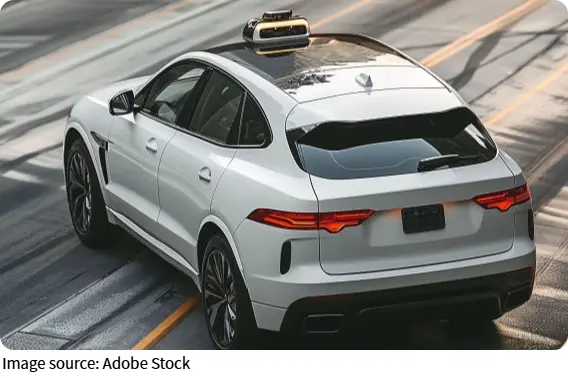
Waymo is the clearest example of real autonomous driving at scale. Its robotaxi service runs in a city in Arizona and Los Angeles, offering fully driverless rides to the public. No backup driver. The vehicles use a combination of lidar, radar, cameras, and detailed HD mapping to navigate complex urban environments in real time. It's not a prototype or a press demonstration — it's a commercial service people use daily.
Cities around the world are running autonomous shuttle pilots, mostly on fixed low-speed routes. In Barcelona, a driverless minibus operates on a 2.2 km circular route without a safety driver. At Zurich Airport, WeRide's autonomous shuttle transports staff on a defined loop. In Japan, autonomous shuttles are being tested specifically to serve aging rural communities where driving capability is declining.
Lyft, in partnership with May Mobility, is preparing to launch autonomous ride-hailing in Atlanta and Dallas. Cruise, which paused operations after a safety incident, is cautiously restarting under stricter conditions.
How These Vehicles Actually Work
Autonomous vehicles combine several sensor systems. Lidar uses lasers to build a continuous 3D map of the surrounding environment. Radar detects objects and their velocity, particularly in low visibility conditions. Cameras read traffic signals, lane markings, and identify pedestrians. Ultrasonic sensors handle close-range tasks like parking. GPS combined with detailed HD maps provides precise positioning.
All of this data feeds into onboard computers that make driving decisions in milliseconds, using AI and machine learning to interpret situations, predict the behavior of other vehicles and pedestrians, and choose appropriate responses. Different companies approach this differently — Waymo uses lidar extensively; Tesla relies solely on cameras and neural networks, arguing that human driving is also camera-based and that lidar is unnecessary.
Why Full Autonomy Is Still Far Off
Despite the real progress, two-thirds of Americans still don't trust autonomous technology, according to a 2024 AAA survey. That skepticism isn't irrational. High-profile incidents involving both Waymo and Cruise vehicles have raised genuine questions about how these systems handle unusual or unpredictable situations.
Cost remains a significant barrier. The lidar systems and AI processing chips required for reliable Level 4 autonomy are expensive, keeping full autonomy out of reach for everyday consumer vehicles. Legal and insurance frameworks haven't caught up with the technology either — liability in an accident involving a Level 4 vehicle remains genuinely unresolved in most jurisdictions.
The benefits on offer are real: AVs could reduce the road accidents in which human error plays a role, improve traffic flow, and give mobility back to people who can no longer drive. A study found that even around 6% of connected autonomous vehicles on the road can meaningfully improve traffic signal coordination and reduce intersection delays. These gains are significant — they just haven't arrived everywhere yet.
So where does that leave the average driver? Still very much in control. The autonomous future is arriving — but in patches, not waves. Waymo proves full driverless rides are possible today in carefully mapped cities. Tesla proves that impressive driver assistance is not full autonomy, no matter the name.
The gap between Level 2 and Level 4 remains wide, filled with legal uncertainty, technical limits, and public skepticism. For now, keep your hands on the wheel. But glance ahead — the road is slowly changing.