AI Keeps Cars Safer

Yuna
| 29-05-2026
 · Automobile team
Most people don't notice the safety systems in modern cars until something goes wrong — or more precisely, until something almost goes wrong and the car intervenes before it does.
A brief steering correction that straightens a drifting lane departure, an automatic brake that fires before your foot reaches the pedal, a gentle alert that the system has noticed you haven't blinked in a while.
These aren't science fiction. They're in production vehicles right now, and AI is what makes them work.
What ADAS Actually Does
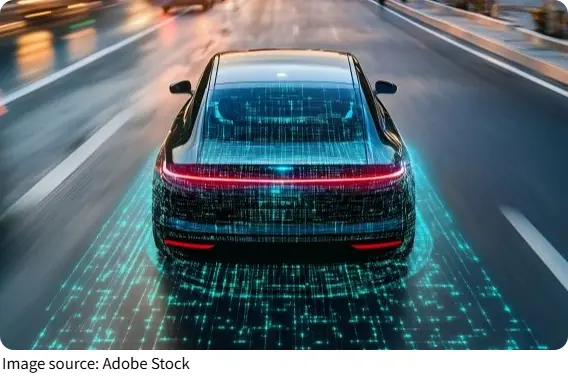
Advanced Driver Assistance Systems — ADAS — are a collection of AI-powered features that make modern vehicles significantly safer than their predecessors. In 2025, these systems moved well beyond basic cruise control. Emergency braking systems can now detect obstacles at distances of up to 200 meters and respond in under a tenth of a second — faster than any human reaction time. Lane management technology can keep a vehicle within its lane even when road markings are faded, missing, or obscured by rain, using a combination of camera data and real-time processing.
Adaptive cruise control has become genuinely sophisticated. Rather than simply maintaining a fixed speed and gap to the vehicle ahead, newer systems factor in detailed road mapping — adjusting speed proactively for curves, elevation changes, and known congestion zones before the driver even sees them. The result is smoother, less stressful highway driving with fewer hard braking moments.
Nearly 60% of new cars sold globally now come equipped with some form of Level 2 autonomy, meaning these AI-assisted driving features are no longer limited to premium vehicles. They've become standard expectations across the mainstream market.
Driver Monitoring: The Camera That Watches You
One of the more quietly significant developments in automotive AI is driver monitoring. An infrared camera, typically mounted on the steering column, watches the driver's face continuously. The AI analyzes eye closure rate, head position, and gaze direction to assess attention levels.
If it detects that the driver hasn't been looking at the road, is showing signs of fatigue, or has eyes closing for unusually long blinks, the system issues an alert — and in some implementations, begins preparing an emergency stop sequence.
The European Union now mandates driver monitoring systems as standard equipment in all new vehicles. The underlying logic is straightforward: a significant proportion of road accidents involve driver inattention or drowsiness, and catching those conditions before they produce consequences is more effective than responding after the fact. A camera that notices you're falling asleep before you do is a genuinely useful piece of safety technology.
AI in the Manufacturing Process
AI's role in car safety doesn't start on the road — it starts on the production line. AI-powered inspection systems can detect micro-defects in components that human visual checks would miss: hairline cracks, microscopic surface irregularities, and dimensional tolerances slightly out of specification.
Identifying these problems before a vehicle leaves the factory reduces warranty claims, improves reliability, and prevents failures that could become safety issues in service.
Machine learning systems trained on real-time factory floor data can also predict when equipment is approaching failure before it breaks down, allowing maintenance to be scheduled proactively. This kind of predictive maintenance reduces defect rates and keeps production quality consistent across large volumes of vehicles.
What's Coming Next
The automotive AI market is projected to more than double between 2025 and 2030, driven by tightening safety regulations, consumer demand for more advanced assistance features, and the ongoing development of higher-level autonomy.
NVIDIA's recently unveiled Halos system integrates hardware and software safety components specifically designed to accelerate the reliable deployment of autonomous vehicles. Mobileye and Valeo are working with Volkswagen to bring enhanced Level 2+ driving assistance — including hands-free highway driving and traffic jam assist — to high-volume mainstream models.
The trajectory is clear. AI in cars has already moved from novelty to expectation, and the safety gains it enables are measurable. Fewer accidents caused by distraction, fatigue, and slow reaction times are the concrete output of systems that process sensor data faster and more consistently than any human driver can.
Next time the car beeps, steers, or brakes without being asked, remember: that brief intervention might be the one you never saw coming. AI in cars is not a distant promise. It is already reducing accidents caused by a blink, a glance at the radio, or a moment of fatigue.
The technology will only become more capable. But even today, those silent, invisible assists add up to something real: fewer crashes, safer highways, and a quiet confidence that the car is paying attention — even when you are not.