How Air Shapes a Car

Kwame Johnson
| 26-05-2026
 · Automobile team
Look at most modern cars: sloped roofline, tapered front, flush doors, and wheel arches that manage airflow.
None of this is accidental. Every surface of a modern car has been tested, simulated, and refined around one central question: how does air behave when this thing moves through it?
The Numbers That Drive the Shapes
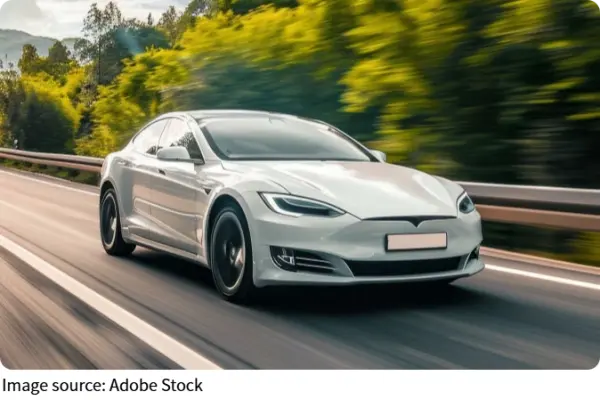
The drag coefficient, or Cd, is how engineers quantify a vehicle's aerodynamic resistance. The lower the number, the less energy the car needs to push through the air. The Tesla Model S has a Cd of 0.208, among the lowest of any production vehicle.
The Mercedes-Benz EQS, designed specifically to maximize electric range, achieves a Cd of 0.20. Standard family hatchbacks typically sit around 0.28 to 0.32. SUVs, with their larger frontal area and boxier shapes, are often higher. Each point of drag coefficient reduction has a direct effect on fuel or energy consumption — and for electric vehicles, where range is still a key buyer concern, minimizing drag translates directly to real-world miles between charges.
This is why EV makers have invested so heavily in aerodynamic engineering: a car that slips through air more efficiently is a car that goes further on the same battery.

What Modern Aerodynamic Features Actually Do
Car bodies are shaped around smooth, continuous surfaces to keep airflow attached to the vehicle rather than separating into turbulent eddies behind it. Teardrop-inspired profiles — wide at the front, tapering toward the back — are consistently the most efficient shapes. Tapered rooflines, fastback profiles, and flush surfaces all serve this purpose.
Under the car matters just as much as on top of it. Flat underbody panels, which are now common on EVs and performance cars, allow air to pass smoothly beneath the vehicle rather than swirling around chassis components and creating drag. Rear diffusers at the back edge of the underbody accelerate exiting air, reducing lift and stabilizing the car at speed.
Wheels are an often-overlooked aerodynamic variable. The spinning turbulence created by exposed wheels is significant, which is why aerodynamically focused EVs frequently use enclosed wheel covers or carefully designed rims with smooth surfaces rather than open spokes.
Some manufacturers have replaced conventional wing mirrors with camera systems mounted in slim housings specifically because traditional mirrors create measurable drag.
Active Aerodynamics: The Car That Adapts
Static design can only go so far. Active aerodynamic systems take the next step by adjusting the car's shape dynamically based on driving conditions. The Porsche 911 Turbo S features a rear wing that adjusts its angle automatically — moving to maximize downforce in cornering, then flattening to reduce drag at high straight-line speeds.
Some vehicles use active grille shutters that close when engine cooling isn't needed, reducing the drag caused by air flowing through the grille and through the engine bay.
Active suspension can also play an aerodynamic role. Lowering the ride height at speed reduces the gap beneath the car, cutting the amount of high-pressure air that can get under the vehicle and create lift. This is why some sports cars drop visibly lower at highway speeds.
The Tension With Aesthetics
Every aerodynamicist's ideal shape would be a smooth, featureless teardrop. Car designers rarely get to make that. Brands have visual identities — signature grilles, characteristic rooflines, distinctive headlight shapes — that buyers recognize and expect, and some of those features create drag.
BMW's kidney grille is a brand signature, but a large open grille increases aerodynamic resistance. The engineering solution is to integrate active shutters that close the grille opening when not needed for cooling, preserving the visual identity while recovering some of the aerodynamic efficiency lost to the design choice.
The Lamborghini Aventador is an extreme example of this negotiation. Its sharp angles and aggressive venting are visually striking and aerodynamically functional at the same time — but the function is downforce for handling rather than low drag for efficiency. Different types of cars optimize for different aerodynamic goals.
A Formula 1 car maximizes downforce at the cost of enormous drag. A long-range EV minimizes drag at the cost of any aggressive styling. Most road cars land somewhere in between, shaped by the specific priorities of their market segment.