Hills, Gold, and Cypress

James Carter
| 08-07-2026
 · Travel team
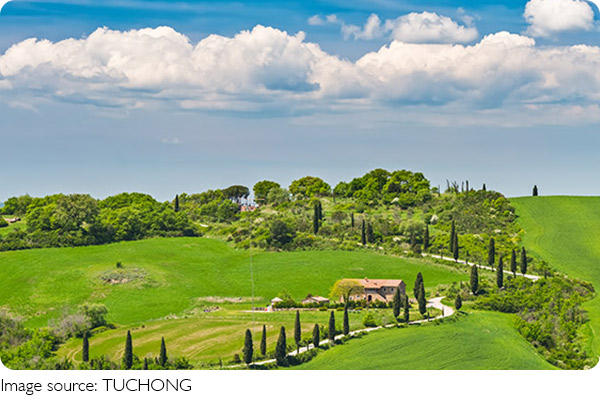
Readers, in central Italy, a landscape of rolling golden hills, dark cypress trees standing like exclamation marks against the sky, medieval stone towers, and sun-warmed vineyards stretches from Florence to the southern valleys of Val d'Orcia. Tuscany is not a single destination—it is an entire region of distinct cities, hilltop villages, and countryside roads that each deliver a different version of the Italian dream. The key to a great Tuscan trip is not seeing everything—it is choosing the right mix of Renaissance art, countryside calm, and hearty food to match your pace.
Florence Highlights
The regional capital is one of the world's greatest art cities. The Uffizi Gallery houses masterworks spanning centuries—standard tickets cost approximately $27 (€25), with an additional $4.35 (€4) reservation fee for advance booking. Early morning tickets at $20.70 (€19) offer slightly lower prices and thinner crowds. A five-day combined pass covering the Uffizi, Palazzo Pitti, and Boboli Gardens costs approximately $41 to $44 (€38 to €40). Free entry is available on the first Sunday of every month, though expect significant queues. The Duomo complex—including the famous dome climb—charges approximately $30 (€27) for a combined ticket. Florence is best navigated entirely on foot—the historic center is compact, and most major sights sit within a 20-minute walk of each other.
Hill Towns
Beyond Florence, Tuscany's hilltop towns offer a dramatically different atmosphere. Siena's medieval center—dominated by the fan-shaped Piazza del Campo—is a UNESCO site that rewards half a day of slow wandering, all free. San Gimignano, famous for its 14 surviving medieval towers, charges no entrance fee for the town itself, though climbing the tallest tower (Torre Grossa) costs approximately $10 (€9). Volterra, perched on a high plateau, features Etruscan ruins and artisan alabaster workshops. Montepulciano and Pienza in the Val d'Orcia valley offer panoramic views, local cheese tastings from $5 to $12, and some of Italy's finest countryside scenery. Regional trains connect Florence to Siena in approximately 1.5 hours for $9 to $16 (€8 to €15) one way.
Countryside Drives
Renting a car unlocks Tuscany's most magical landscapes. The SR222 through the hills winds past estates, stone farmhouses, and olive groves. Val d'Orcia's UNESCO-listed landscape—famous for its lone cypress trees, rolling wheat fields, and golden light—is best accessed by car from Siena or Montepulciano. Car rental from Florence airport starts from approximately $35 to $70 per day during shoulder season, with fuel costing approximately $2 per liter. Avoid driving into historic city centers—ZTL (restricted traffic zones) impose automatic fines of $100+ for unauthorized vehicles, detectable even weeks after departure.
Farm Stay Experience
The agriturismo—a working farm or offering guest accommodation—is Tuscany's signature lodging experience. These properties range from rustic stone cottages to restored villas with pools and panoramic views. Rates typically run $77 to $130 (€70 to €120) per night, often including breakfast with farm-produced eggs, bread, olive oil, and preserves. Many agriturismos offer cooking classes ($50 to $90 per person), guided estate walks, and harvest-season activities. Booking through platforms like Agriturismo.it or directly through property websites secures the best rates. Properties near Siena, Pienza, and the region are the most popular.
City Accommodation
Florence hotels span every budget tier. Hostels and budget guesthouses start from approximately $33 to $55 (€30 to €50) per night. Mid-range hotels in the historic center range from $65 to $165 (€60 to €150) nightly, with rates spiking during September and major holiday periods. Boutique properties near the Ponte Vecchio or Santa Croce command $165 to $330 (€150 to €300). Siena offers slightly lower prices—mid-range hotels within the old walls cost $55 to $130 (€50 to €120) per night.
Eating Tuscany
Tuscan cuisine is built on simplicity—fresh bread, olive oil, seasonal vegetables, and handmade pasta dominate local menus. A full meal at a traditional trattoria costs $15 to $28 (€14 to €25) per person, typically including primo (pasta), secondo (grilled or roasted main), and contorno (vegetable side). Street food in Florence—schiacciata sandwiches, fresh pizza slices, and gelato—costs $4 to $8 per item. Market lunches assembled from local grocers and bakeries run $8 to $14 for two. Tipping is not expected but rounding up by a euro or two is appreciated.
When to Visit
Late spring (May to June) and early autumn (September to October) deliver the best combination of warm weather, golden light, and manageable crowds. Summer (July to August) brings peak heat—often exceeding 35 degrees Celsius in Florence—and peak prices. Winter (November to March) offers the lowest accommodation rates (often 30 to 40 percent below peak) and a quieter, more local atmosphere, though some countryside properties close seasonally.
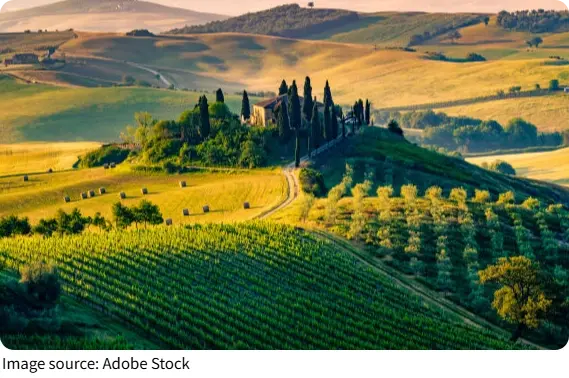
Friends, Tuscany earns its reputation not through any single landmark but through the cumulative effect of hills that glow gold at sunset, towns that have barely changed in 500 years, and meals that make you reconsider everything you thought about simple ingredients. Have you ever visited a place where the landscape, the food, and the history felt so perfectly intertwined that leaving felt like stepping out of a painting?