The Tallest Veil of Water
Antonio
| 25-05-2026
 · Travel team
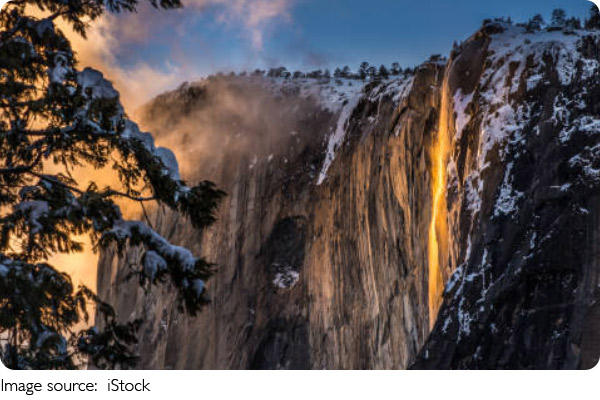
Lykkers, in the heart of California's Sierra Nevada, a ribbon of white water drops 2,425 feet down a granite face in three stages—making Yosemite Falls the tallest waterfall in North America.
The falls plunge into a valley so dramatic that the first people to describe it struggled to find words large enough.
Yosemite Valley, with its towering cliffs, ancient sequoia groves, and meadows that glow gold at sunset, has been drawing visitors for over 150 years. Standing at the base of the falls as mist settles on your face, the reason becomes visceral.
Lower Falls Trail
The most accessible way to experience Yosemite Falls is the Lower Yosemite Fall Loop—a flat, paved, one-mile trail that circles to the base of the lower cascade. The walk takes roughly 20 to 30 minutes and is suitable for families, strollers, and visitors of all fitness levels.
During peak flow months of May and June, the mist near the base soaks everything within 50 feet, so waterproof jackets earn their weight. The trail is free to walk—no separate ticket is needed beyond the park entrance fee. Views of both the upper and lower falls from Cook's Meadow, accessible via a connecting flat path, deliver the iconic postcard composition.
Upper Falls Hike
For those seeking a physical challenge and a truly earned view, the Yosemite Falls Trail climbs 2,700 feet over 7.2 miles round trip to the top of the falls. The hike takes most visitors five to eight hours and ranks among the park's most strenuous day hikes.
Even tackling just the first two miles to Columbia Rock rewards hikers with sweeping panoramic views of Yosemite Valley, Half Dome, and Sentinel Rock. Carrying at least two liters of water per person, wearing sturdy hiking boots, and starting before 8:00 AM are non-negotiable on this route. The trail is free.
Seasonal Flow
Timing matters enormously at Yosemite Falls. Peak water volume occurs during late May and early June, when snowmelt from the high country feeds the falls at their most thunderous. By late July, the flow diminishes noticeably, and by August or September the falls may slow to a thin trickle—or stop entirely in dry years.
Visiting during spring guarantees the most dramatic experience, though it also brings the heaviest crowds and occasional trail closures due to wet, icy conditions.
Park Entrance
Yosemite National Park charges $35 per vehicle, valid for seven consecutive days. The Yosemite Annual Pass costs $70, while the America the Beautiful Pass at $80 covers all U.S. national parks for 12 months. Motorcycles enter for $30, and pedestrians or cyclists pay $20 per person.
During peak summer weekends and holidays, timed-entry reservations may be required in addition to the entrance fee—checking the official NPS website before travel is essential.
Valley Accommodation
Yosemite Valley Lodge, the closest in-park lodging to the falls, offers comfortable hotel-style rooms with rates typically ranging from $300 to $600 per night during peak season. Curry Village provides a more budget-friendly option with canvas tent cabins starting from approximately $190 to $350 nightly—shared bathroom facilities keep costs lower, and the rustic atmosphere adds character.
The Ahwahnee, the park's historic luxury property, commands $500 to $1,000+ per night. All in-park accommodation books six to twelve months in advance for summer dates—last-minute availability is extraordinarily rare.
Yosemite National Park
Outside the Park
Gateway towns offer significantly more affordable options. El Portal, just five minutes from the park's western entrance, provides hotels and vacation rentals from $150 to $300 per night. Mariposa, roughly 45 minutes away, offers motels and guesthouses from $100 to $200. Oakhurst, near the southern entrance, has chain hotels starting from $90 to $180.
These towns also provide restaurants, grocery stores, and fuel stations—all at lower prices than inside the park. Dining inside Yosemite ranges from casual cafeteria meals at $12 to $20 to fine dining at The Ahwahnee for $50 to $90 per person.
Getting Around
Yosemite Valley operates a free shuttle bus system connecting major trailheads, lodges, and visitor services every 10 to 20 minutes throughout the day. Parking at popular trailheads fills by mid-morning during summer, making the shuttle system not just convenient but often necessary.
The nearest major airports are Fresno-Yosemite International (approximately 2.5 hours by car) and San Francisco International (approximately 4 hours). Car rental from regional airports runs $40 to $100 per day.
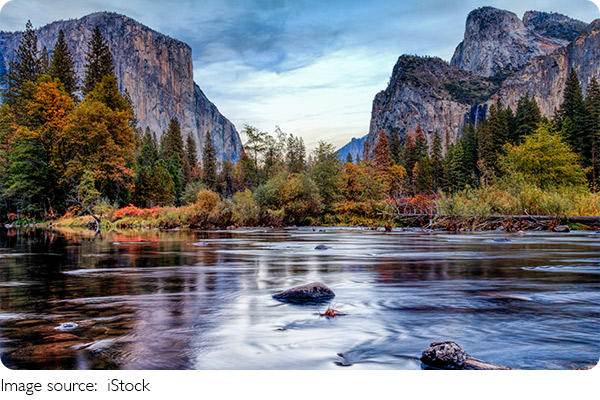
Lykkers, Yosemite Falls is a place where the sheer scale of nature leaves even experienced travelers searching for adjectives. The sound, the spray, the granite walls rising impossibly high on every side—it all combines into a moment that photographs can only hint at. If you have been waiting for a sign to visit, consider this granite cliff, this falling water, and this valley calling your name from across the continent.