The Kangaroo's Pouch

Santosh Jha
| 23-03-2026
 · Animal team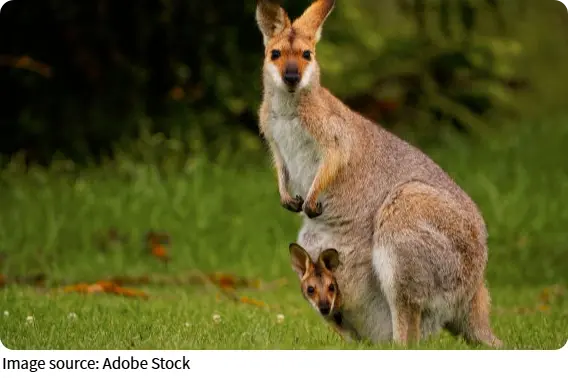
We step into the vast grasslands and forests of Australia, home to one of the continent’s most iconic animals – the kangaroo. Famous for their powerful hind legs and graceful leaps, kangaroos are a symbol of wild beauty.
But the real wonder lies in the female kangaroo’s pouch – a natural nursery that seems to tell a story of life, growth, and survival. It makes us curious: what secrets does this small pouch hold?
The Anatomy of the Pouch
The pouch is formed from folds of skin on the kangaroo’s belly, creating a private space for its baby. Inside, it stays warm and protected as the mother’s body temperature is gently transferred to the tiny joey. For newborns, whose ability to regulate body heat is weak, this warmth is crucial—it keeps them safe from sudden temperature changes.
Beyond warmth, the pouch has special features to protect the joey. Muscles around the opening allow the mother to open and close it with precision. When danger appears, the pouch can be quickly sealed, keeping the joey secure. When it’s time to feed or move, the pouch opens easily. This natural control acts like a built-in safety lock, always guarding the little one.
Milk That Adapts to Growth
Inside the pouch, four feeding points provide nourishment. Amazingly, the milk changes composition as the joey grows. Right after birth, the milk is rich in protein and nutrients but low in sugar, giving the tiny joey the energy it needs to grow fast. As the joey develops, the milk gradually shifts to higher sugar and lower protein and nutrients, matching its changing needs perfectly.
A Joey’s First Journey
Kangaroos are marsupials, which means their gestation is extremely short—about 30 to 40 days. So, the newborn joey is tiny, roughly 1 gram, pink, blind, hairless, and fragile—like a tiny bean struggling in the vast outdoors. But nature provides a safe haven: the pouch.
Guided by instinct, the newborn crawls from the birth canal to the pouch along a moist path created by the mother’s licking. Though blind, the joey uses its strong forelimbs and keen sense of smell to find its way. Once inside, it finds a feeding point and begins receiving nourishment. For the first months, the pouch provides a warm, secure environment where the joey can grow safely.
Growing Up in Comfort
In the pouch, the joey slowly matures. Eyes open, ears become alert, and fur starts to grow. Limbs strengthen, and the joey begins to explore the pouch itself. Around six to seven months, the joey shows curiosity about the outside world, peeking out while still returning to the warmth and security of the pouch. Gradually, it starts tasting grass and plants, learning to adjust to the outside environment while still relying on the mother.
Evolution’s Clever Design
Australia’s natural environment is harsh and unpredictable, with deserts, grasslands, and forests. For a fragile newborn, the outside world is full of danger. The pouch acts as a protective fortress, shielding the joey from heat, cold, and storms. Temperatures in the pouch remain stable even when the desert heat soars above 50°C.
The pouch also boosts survival rates, ensuring that more joeys reach maturity. In the wild, young kangaroos face predators, disease, and other threats. The mother’s pouch serves as a life-support system, providing nutrition, protection, and comfort. Kangaroos can even have multiple joeys at different stages of development, with the pouch allowing efficient care and continuous reproduction, ensuring the population thrives.
Nature’s Masterpiece
The kangaroo’s pouch is a marvel of evolution. It provides warmth, nourishment, and protection, guiding the joey from a tiny, fragile newborn to a curious, independent young kangaroo. Watching this process, we can appreciate how nature combines innovation and survival, creating a small but powerful world where life thrives.
Life Inside the Pouch
Next time we think of kangaroos, let’s imagine the tiny, hidden world inside their pouches—a place where life begins with care, warmth, and precision. It’s a reminder of nature’s ingenuity and the small miracles that happen every day. For us, seeing this up close sparks wonder and connection to the incredible journey of life.